
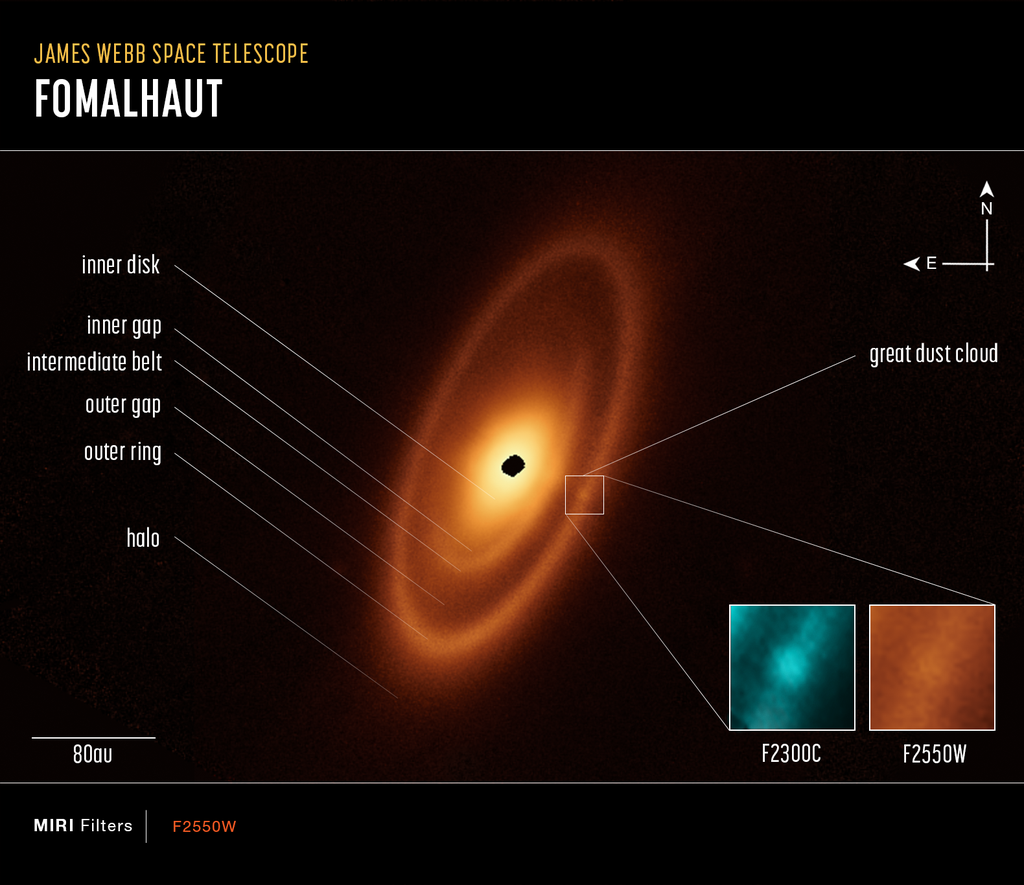

The James Webb Space Telescope has found more than just an asteroid belt around the star Fomalhaut, according to a new study published in the journal Nature. The telescope’s observations revealed a vast and complex system of dust, gas, and planetesimals that is still in the process of forming planets.
Fomalhaut is a young star, about 25 million years old. It is located about 25 light-years from Earth. The star is surrounded by a large disk of dust and gas, which is thought to be the birthplace of planets.
Previous observations of Fomalhaut’s disk had revealed the presence of an asteroid belt, similar to the one that lies between Mars and Jupiter in our own solar system. However, the Webb telescope’s observations were much more detailed, and they revealed a much more complex system.
The telescope’s infrared vision allowed it to see through the dust and gas to the objects that lie within the disk. The observations revealed a vast array of planetesimals, which are small bodies that are thought to be the building blocks of planets. The planetesimals in Fomalhaut’s disk range in size from a few meters to tens of kilometers across.
The observations also revealed a large amount of dust and gas in the disk. This dust and gas is thought to be the raw material from which the planetesimals formed.
The Webb telescope’s observations of Fomalhaut’s disk provide new insights into the process of planet formation. The observations suggest that planet formation is a complex and chaotic process that can take millions of years to complete.
The study’s lead author, Dr. Alyssa Goodman of the Harvard-Smithsonian Center for Astrophysics, said, “The Webb telescope has given us a new window into the early days of our own solar system. The observations of Fomalhaut’s disk show us that planet formation is a messy and chaotic process, but it is also a process that is full of potential.”
The Webb telescope’s observations of Fomalhaut’s disk are a significant milestone in the search for life beyond Earth. The observations suggest that the conditions for life may be present around other stars. The Webb telescope is expected to make many more discoveries in the years to come, and it is likely to play a major role in the search for life beyond Earth.
©️ Rocky Mountain Dispatch 2023
Leave a Reply