Our Store

The Rocky Mountain Dispatch — Monday, November 23, 2026 | Continuous Digital Edition

The Rocky Mountain Dispatch

Independent Colorado News • Continuous Digital Broadsheet

Monday, November 23, 2026 Colorado Springs, Colorado Becht Media Ltd. • rockymountaindispatch.com

Colorado Pitches $8.2 Billion U.S. Space Academy Campus at Banning Lewis Ranch in Colorado Springs

State proposal pairs a 321-acre permanent east-side campus with interim 2028 classes at UCCS as a presidential commission prepares its site recommendation.

Panoramic sunrise view over Colorado Springs looking west toward Pikes Peak
Pikes Peak Region Bid: Colorado officials are pitching an $8.2 billion U.S. Space Academy campus at Banning Lewis Ranch in Colorado Springs. (Photo via Pikes-Peak.com)

Colorado officials have formally submitted a sweeping $8.2 billion bid to bring the proposed United States Space Academy to Colorado Springs, positioning the Pikes Peak region as the natural home for the nation’s next federal service institution. Endorsed by Gov. Jared Polis, the state’s pitch centers on a large east-side site inside Banning Lewis Ranch, where planners envision a permanent campus integrated directly with aerospace research and defense industry partners.

Under the submitted blueprint, the first class of Space Academy students would begin coursework in 2028 at the University of Colorado Colorado Springs while construction proceeds on the permanent facilities. The proposed Banning Lewis Ranch property, owned by Norwood Development Group, sets aside a 321-acre parcel for the core academic and cadet campus alongside an adjacent 187-acre district reserved for research laboratories and commercial aerospace partners.

Financing the ambitious project would rely on coordinated state and federal action. According to the state’s proposal, Colorado lawmakers would be asked to adopt legislation allowing the state to direct new sales and property tax collections generated by the development toward campus construction costs. Federal congressional cooperation would then be required to fund the academy’s ongoing annual operations once the institution opens.

Supporters across the Pikes Peak region argue that Colorado Springs’ existing concentration of space operations, military installations, and defense contractors gives the state an unmatched operational advantage. Gov. Polis emphasized that Colorado is taking the bid seriously and argued that selecting the site should remain focused on national space readiness rather than political considerations.

With a recommendation from the presidential commission expected within weeks, regional business leaders and editorial voices are urging Colorado’s entire congressional delegation to unite behind the pitch. If selected, the U.S. Space Academy would anchor decades of aerospace education and workforce development along the Front Range.

Statewide Proposal Snapshot • Banning Lewis Ranch Bid

Colorado’s U.S. Space Academy Pitch by the Numbers

Key benchmarks outlined in the state’s formal submission ahead of the presidential commission’s site recommendation.

$8.2 Billion
Estimated total campus buildout proposed for Colorado Springs
321 Acres
Dedicated campus parcel at Banning Lewis Ranch
187 Acres
Adjacent research and aerospace industry partner district
2028 Start
Target year for initial classes hosted at UCCS during buildout

Source: State of Colorado U.S. Space Academy submission details reported by CPR News, The Colorado Sun, and The Gazette (Nov. 2026).
Pikes Peak Region & Courts

Questions Mount After Colorado Springs Homicide Confession Leads to No Criminal Charges

Newly examined police transcripts from a 2022 Ridgeview Place Apartments shooting detail why the 22-year-old victim’s family is demanding accountability.

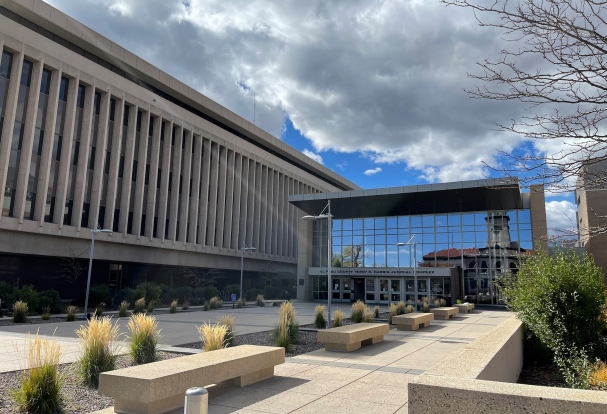
Exterior view of the El Paso County Judicial Building in Colorado Springs
El Paso County Judicial Building: Prosecutors in the 4th Judicial District declined to file criminal charges following a 2022 fatal shooting confession. (Photo by Kayla Cooley / Colorado Judicial Branch)

A newly published investigation into a fatal 2022 Black Friday shooting in Colorado Springs is drawing fresh scrutiny to prosecutorial decision-making after records showed a man who confessed to killing his roommate never faced criminal charges. According to 450 pages of Colorado Springs Police Department documentation reviewed by reporters, Cameron Wilson admitted to detectives that he shot 22-year-old Jacob Langley two or three times through a vehicle’s passenger-side window during a parking-lot confrontation at the Ridgeview Place Apartments.

Police records indicate the dispute began over household trash and escalated as Langley and his partner, Andrea Bettis, were moving belongings out of the apartment. Witnesses told investigators the two couples clashed in the parking lot, and two apartment residents who called police reported seeing Langley pointing a firearm taken from Wilson’s collection. After Langley’s car struck another vehicle in the lot, Wilson fired hollow-point rounds through the passenger glass before fleeing the scene.

Officers who arrived at the complex applied a tourniquet to Langley’s arm and recovered a firearm from the car he was driving, but the young father later died at the hospital after a bullet passed through his arm and into his chest. Wilson subsequently returned to the apartment complex, turned himself in, and gave a formal statement telling detectives he acted to protect his pregnant wife while also expressing regret in the interrogation room.

Following the interview, detectives informed Wilson that a representative from the 4th Judicial District Attorney’s Office was not comfortable bringing criminal charges. Police released Wilson and drove him to a location of his choosing, and a Colorado Bureau of Investigation records check confirmed he was never arrested in connection with the killing.

Four years later, Langley’s family continues to seek transparency and accountability over how the case was handled. Bettis, who is raising the couple’s now five-year-old daughter, Adelita, questioned how someone could confess to fatally shooting another person and walk away without facing a courtroom review.

Conservation Partnership Passes Halfway Mark Around Air Force Academy Training Airstrip

Land trusts have now preserved 26,200 acres of the 48,000-acre Bohart Ranch surrounding the Bullseye Auxiliary Airstrip east of Colorado Springs.

U.S. Air Force Academy training aircraft parked along the airfield tarmac with Pikes Peak in the background
Protecting Flight Training: Land trusts have preserved more than half of the 48,000-acre Bohart Ranch buffering Air Force Academy aviation operations. (U.S. Department of Defense photo)

A multi-organization conservation effort designed to buffer a vital U.S. Air Force Academy pilot training facility from encroachment has officially crossed the halfway point. A partnership uniting the Palmer Land Conservancy, the Trust for Public Land, and The Nature Conservancy announced it has now acquired 26,200 acres of the 48,000-acre Bohart Ranch surrounding the Bullseye Auxiliary Airstrip east of Colorado Springs.

The Bullseye Auxiliary Airstrip serves as a critical off-base training field where Air Force Academy cadets and flight instructors practice landings and touch-and-go maneuvers. Preserving the surrounding grassland and stabilized dune landscape prevents incompatible residential or industrial development from crowding the airspace and jeopardizing flight-training safety.

The conservation partners are purchasing the sprawling ranch in phases from the Colorado State Land Board, which manages state trust properties to generate revenue for public education, including through agricultural or energy leases. By transitioning the land into permanent conservation status, the coalition balances state educational funding mandates with long-term open-space stewardship.

The initiative also aligns with broader federal Readiness and Environmental Protection Integration efforts aimed at safeguarding the Air Force Academy’s nearly $1 billion in annual economic contributions to the Pikes Peak region. Rapid growth along the eastern plains and northern El Paso County has made proactive land buffering an increasingly urgent priority for military planners.

Project leaders estimate the remaining acquisitions needed to complete the full 48,000-acre preservation plan will take roughly three more years. Once finished, the protected corridor will stand as one of the largest contiguous conservation buffers supporting military aviation readiness in southern Colorado.

Thanksgiving Travel & Colorado Sports

Thanksgiving Week Travel Surge Hits Colorado Springs Roads and Airport

El Paso County gas prices sit at $3.22 a gallon as COS Airport braces for up to 5,000 daily passengers on peak return day.

Interior concourse of the Colorado Springs Airport with travelers walking past signage
Colorado Springs Airport: Officials project daily holiday traffic to average 4,000 passengers and peak near 5,000 on Sunday, Nov. 29. (Photo via Axios)

Thanksgiving week travel is officially underway across the Pikes Peak region, with both highways and airport terminals preparing for heavy holiday crowds matching last year’s busy pace. Nationally, AAA projects 81.5 million Americans will travel over the holiday stretch, with nearly 90 percent making the trip by car despite lingering inflation concerns.

Local drivers heading out of El Paso County are seeing some relief at the pump compared to earlier autumn price spikes. According to AAA Colorado, regular gasoline in El Paso County averages $3.22 per gallon, well below the statewide average of roughly $3.50 and the national average of $3.69. Even so, statewide fuel prices remain about 25 percent higher than a year ago, prompting a noticeable uptick in bus and rail travel across the Mountain West.

At the Colorado Springs Airport, officials expect daily passenger traffic to climb from a typical 3,000 to 4,000 travelers to an average of 4,000 per day throughout the holiday window. Airport leaders project traffic will peak on Sunday, Nov. 29, with roughly 5,000 passengers moving through terminals, and are advising flyers to arrive at least 90 minutes before departure.

Up Interstate 25, Denver International Airport is anticipating 776,000 screened travelers across the 11-day holiday period, up 1.3 percent from last year’s actual count. Wednesday, Nov. 25, is projected to be the busiest pre-holiday air travel day at both Denver and Colorado Springs airports before return crowds surge on Sunday.

Traffic analysts with Inrix and the Colorado Department of Transportation warn that Tuesday and Wednesday afternoons will bring the heaviest congestion along Front Range corridors linking Denver, Colorado Springs, and Fort Collins. Motorists heading into the high country on Interstate 70 are also advised to plan around heavy westbound traffic on Friday and eastbound return delays on Saturday.

Turnovers and Cold Perimeter Shooting Stall Air Force Men’s Basketball in 90–68 Loss to UTSA

Lucas Hobin scores 21 points and Caleb Walker adds 18, but the Roadrunners turn 18 Falcons miscues into 31 points at the Military Classic.

Air Force Falcons men’s basketball game action inside Clune Arena
Air Force Men’s Basketball: The Falcons look to bounce back against Army West Point on Tuesday after falling 90–68 to UTSA in San Antonio. (Photo via DVIDS)

Offensive miscues and defensive lapses in the half-court proved costly for the Air Force men’s basketball team on Saturday afternoon as the Falcons fell 90–68 to UTSA at the Military Classic presented by USAA. Played at the UTSA Convocation Center, the defeat dropped Air Force to 3–3 on the young season and extended the Falcons’ search for their first road victory after three away losses.

After two early lead changes, UTSA seized control with a decisive 10–0 run that helped the Roadrunners build a commanding 45–27 halftime advantage. Air Force committed 18 turnovers across the contest, and UTSA capitalized relentlessly by converting those mistakes into 31 points while shooting an efficient 50 percent from the floor.

Sophomore Lucas Hobin provided the brightest spark for the Falcons in his home state of Texas, finishing with a team-high 21 points and seven rebounds while going a perfect 7-for-7 at the free-throw line. Senior Caleb Walker contributed 18 points and eight rebounds, drawing seven fouls and converting eight of 13 free-throw attempts, while sophomore guard Kam Sanders added 10 points and four assists.

Beyond the top three scorers, Air Force struggled to generate consistent outside shooting. Sophomore Ethan Greenberg chipped in nine points off the bench on three 3-pointers, but the Falcons finished just 5-for-17 from beyond the arc for 29.4 percent. UTSA countered with six players in double figures, led by Isaiah Watts with 16 points, JJ Kelly with 15, and 14 apiece from Preston Turner and Isaiah Coleman.

Following the loss, head coach Joe Crispin pointed to half-court defense and perimeter shot-making as immediate priorities for improvement. Air Force will get a quick chance to bounce back in San Antonio on Tuesday, Nov. 24, when the Falcons return to the UTSA Convocation Center to face fellow service academy Army West Point at 6 p.m.

Holiday Travel Data • AAA Colorado (Nov. 22, 2026)

Thanksgiving Week Regular Gasoline Price Comparison

Average price per gallon of regular unleaded fuel heading into the 2026 Thanksgiving travel stretch.

El Paso County$3.22 / gal
Local Low: $3.22
Colorado Statewide$3.50 / gal
State Avg: $3.50
U.S. National Average$3.69 / gal
National: $3.69

Source: AAA Colorado and The Gazette (Nov. 22, 2026). Colorado Springs Airport projects 4,000 average daily passengers over the holiday period, peaking at 5,000 on Sunday, Nov. 29.

Science & Space News

Gravitational-Wave Mass Gap Suggests Many Massive Stars Collapse Silently Into Black Holes Without Exploding

Caltech-led analysis of 257 black hole mergers from LIGO, Virgo, and KAGRA uncovers a sharp pileup near 10 solar masses and a surprising shortage between 12 and 16 solar masses.

Illustration of two black holes spiraling together and radiating gravitational waves
Gravitational-Wave Census: A decade of LIGO–Virgo–KAGRA detections points to massive stars collapsing directly into black holes without supernovae. (Illustration courtesy of LIGO/Caltech)

A new Caltech-led study of ripples in spacetime is reshaping how astrophysicists think massive stars end their lives, suggesting that a substantial population of heavy stars never explode as brilliant supernovae at all. Instead, researchers found compelling gravitational-wave evidence that many massive stars collapse quietly and directly into black holes without producing a visible stellar explosion.

Using a decade of detections compiled by the international LIGO–Virgo–KAGRA gravitational-wave observatory network, the research team examined 257 colliding black hole mergers. By mapping the masses of the merging objects across that large statistical sample, the scientists spotted an unmistakable structural pattern hidden inside the cosmic census.

Roughly three-quarters of the black holes in the merger sample clustered tightly around 10 times the mass of the Sun. Immediately above that dense pileup, however, black holes weighing between 12 and 16 solar masses were unexpectedly scarce, creating a distinct mass gap that traditional supernova models struggled to explain.

Astrophysicists note that when a massive star exhausts its nuclear fuel and undergoes a failed supernova, its core implodes directly into a black hole rather than blasting its outer layers across space. That quiet collapse pathway naturally channels dying stars into specific mass ranges, helping account for why 10-solar-mass black holes dominate the gravitational-wave catalog.

The findings underscore how gravitational-wave astronomy has evolved from confirming Einstein’s predictions into a precision tool for studying stellar evolution. As LIGO, Virgo, and KAGRA upgrade their sensitivity in coming observing runs, astronomers expect hundreds of additional merger detections to test how often massive stars vanish in silence across the universe.

Astrophysics Data • Caltech / LIGO–Virgo–KAGRA Network

Key Patterns in the 257-Merger Black Hole Census

Observational highlights supporting direct-collapse black hole formation without supernova explosions.

257 Mergers
Gravitational-wave black hole collisions analyzed over a decade
~75% Share
Proportion of sampled black holes clustered near 10 solar masses
12–16 M☉
Unexpectedly scarce mass range forming a distinct gap
Direct Collapse
Quiet core implosion without a visible supernova explosion

Source: Caltech and LIGO–Virgo–KAGRA Collaboration study summary (Nov. 2026).


Beaver Supermoon Rises Monday Evening, Launching a Four-Month Run of Consecutive Supermoons

Skywatchers across Colorado get prime eastern-horizon views Monday and Tuesday nights before December’s larger Cold Moon arrives.

Bright full supermoon rising in a deep blue night sky
Beaver Supermoon: Monday and Tuesday evenings offer prime eastern-horizon viewing as a four-month run of supermoons begins. (Stock preview via iStock)

Skywatchers across Colorado can step outside Monday evening for the opening act of a rare four-month run of consecutive supermoons. The November full moon, traditionally known as the Beaver Moon, reaches exact peak illumination on Tuesday, Nov. 24, at 7:53 a.m. Mountain Time, making both Monday evening, Nov. 23, and Tuesday evening, Nov. 24, ideal windows to watch the oversized lunar disk rise over the eastern plains.

A supermoon occurs when the full phase coincides closely with perigee, the point in the Moon’s elliptical orbit where it swings nearest to Earth. At its closest approaches, a supermoon can appear up to 14 percent larger and roughly 30 percent brighter than the smallest full moons of the year, giving moonrise an especially striking glow near the horizon.

While the November Beaver Supermoon is the farthest from Earth of the four upcoming events, it sets up an escalating winter skywatching sequence. Next month’s Cold Moon on Dec. 23 will be the largest and brightest full moon of 2026, followed by consecutive supermoons in January 2027 with the Wolf Moon and February 2027 with the Snow Moon.

Because peak illumination happens during morning daylight hours across the United States, astronomers recommend looking east shortly after sunset on Monday or Tuesday. Viewing the Moon while it sits low above distant buildings or eastern Colorado ridges also amplifies the familiar moon illusion, making the glowing orb appear even larger to the naked eye.

No telescopes or specialized equipment are needed to enjoy the display, though a basic pair of binoculars will sharpen views of the lunar maria and bright ray craters. Clear Front Range autumn skies should give Colorado families a crisp preview of winter’s lunar showcase ahead of the Thanksgiving holiday.

Astronomers Catch Giant Star Actively Swallowing Its Companion in First-Ever Direct Observations

Research published in Nature pairs three years of advance tracking with James Webb Space Telescope aftermath views in the Andromeda galaxy.

Four-panel artist’s concept illustrating the stages of a giant star swallowing its companion star
Stellar Engulfment: Four-stage illustration showing the quiescent, precursor, eruption, and post-eruption phases of a stellar merger. (Illustration via Live Science)

For the first time in astronomical history, researchers have directly observed a bloated giant star actively engulfing and merging with its smaller stellar companion. Detailed in a study published in the journal Nature and led by Columbia University postdoctoral researcher and NASA Hubble Fellow Viraj Karambelkar, the cosmic collision unfolded inside the neighboring Andromeda galaxy.

The larger star involved in the encounter was a luminous giant shining 18,000 times brighter than the Sun. As massive stars near the end of their lifespans and exhaust core fuel, their inner cores contract while intense internal heat drives their outer atmospheres to balloon outward—in this case puffing up to roughly 350 times the Sun’s diameter.

Orbiting that expanding giant at roughly the distance between Mars and the Sun was a smaller companion measuring about 70 percent of the Sun’s diameter. Astronomers identified the impending engulfment nearly three years before the final plunge, allowing them to monitor the system step by step as the companion spiraled deeper into the giant’s outer layers and triggered a violent eruption.

To capture the immediate aftermath, NASA’s James Webb Space Telescope joined the campaign on Dec. 24, 2025, through an urgently approved Director’s Discretionary Time observation just 47 days after the eruption. Webb’s infrared instruments confirmed that the two stars had fully merged into a single surviving object surrounded by rapidly evolving debris.

Astrophysicists have theorized for decades that stellar engulfments shape a wide variety of exotic binary systems, nebulae, and stellar remnants across the cosmos. Having a direct, end-to-end observational record gives scientists a crucial benchmark for modeling how stars interact and combine throughout the universe.


NIST Physicists Use Quantum Entanglement to Verify Physical Location and Thwart Hackers

New Nature study demonstrates a light-speed challenge-response protocol that could one day safeguard power grids, banks, and secure facilities.

Laser beam passing through optical lenses and mirrors on a quantum physics laboratory table
Quantum Optics Security: NIST physicists used entangled photons to verify physical location at the speed of light. (Stock preview via iStock)

Physicists at the National Institute of Standards and Technology have demonstrated a new cybersecurity technique powered by quantum entanglement that can verify a person’s exact physical location, making remote impersonation dramatically harder for hackers and scammers. Published online in Nature on Nov. 18, the experiment led by Gautam Kavuri, Krister Shalm, Marty Stevens, and colleagues proved that quantum position verification can work even with remote, untrusted devices.

Today’s digital banking transfers and infrastructure controls rely heavily on passwords, encryption keys, and security tokens that skilled attackers can sometimes steal or spoof from anywhere in the world. The NIST protocol adds a fundamentally different layer of defense grounded in the laws of physics rather than secret codes alone.

In the laboratory test, two verifiers positioned on opposite sides of a claimed location ran a tightly timed quantum challenge-response exchange with a third party known as the prover. One verifier generated a pair of entangled photons, kept one photon, and sent the other through optical fiber to the prover while both verifiers transmitted randomized instructions timed to arrive simultaneously.

Because nothing can travel faster than the speed of light, any attempt by a remote impostor to intercept the signals from another location introduces a measurable delay that immediately exposes the fraud. The entanglement between the photons further prevents an eavesdropper from secretly copying or manipulating the quantum state without leaving a trace.

While NIST researchers caution that deploying the system on real-world quantum networks remains a decade or more away, the potential applications span critical infrastructure and finance. Future versions could block unauthorized remote commands to nuclear plants, power grids, and water treatment facilities, secure high-value stock trades, and defeat phishing schemes operating from spoofed locations.

NASA Highlights Juno Views of Jupiter’s Swirling Clouds as Scientists Probe Deep Atmospheric Chemistry

Color-enhanced spacecraft imagery spotlights an enduring planetary mystery: which trace molecules paint the gas giant’s vivid bands.

Color-enhanced close-up from NASA’s Juno spacecraft showing swirling cloud bands on Jupiter
Jupiter’s Turbulent Clouds: Color-enhanced imagery from NASA’s Juno spacecraft highlights ongoing research into ammonium hydrosulfide and deep atmospheric chemistry. (Photo: NASA/JPL-Caltech/SwRI/MSSS)

NASA has spotlighted a dramatic color-enhanced view of Jupiter’s turbulent upper atmosphere captured by the robotic Juno spacecraft, renewing focus on one of planetary science’s longest-standing mysteries: what exactly creates the vivid reds, browns, golds, and blues swirling across the solar system’s largest planet. Featured as NASA’s Astronomy Picture of the Day for Nov. 22, the imagery stems from Juno’s 14th low-altitude swoop over the gas giant.

Jupiter’s thick atmosphere consists overwhelmingly of hydrogen and helium, both of which are completely colorless at the frigid temperatures of the planet’s cloud tops. As a result, planetary scientists have spent decades investigating which trace chemical compounds rise from Jupiter’s interior and react with ultraviolet sunlight to dye its sprawling belts and storm vortices.

For years, textbooks assumed Jupiter’s primary visible cloud deck was composed mostly of frozen ammonia ice crystals. However, collaborative research pairing professional astronomers with Colorado amateur astronomer and citizen scientist Steven Hill showed that the main clouds sit deeper in the atmosphere than previously believed—at altitudes too warm for pure ammonia ice to condense.

Instead, spectral observations point to ammonium hydrosulfide mixed with photochemical smog as the leading ingredients behind the planet’s distinctive reddish and brownish hues, while smaller high-altitude white clouds likely remain ammonia ice formed in rapid updrafts. Complementing those observations, a 2026 University of Chicago atmospheric simulation revealed that gases circulate through Jupiter’s chemical maze far more slowly than earlier models assumed, taking weeks rather than hours to cross atmospheric layers.

Juno continues to swing past Jupiter in its looping elliptical orbit every 33 days, mapping fresh atmospheric sectors with each close pass. Together, spacecraft data, advanced chemical modeling, and citizen-science telescope observations are steadily peeling back the hidden physics beneath the gas giant’s restless storms.

The Rocky Mountain Dispatch • Published by Becht Media Ltd. • Colorado Springs, Colorado • rockymountaindispatch.com
Continuous Digital Edition • Monday, November 23, 2026

The Rocky Mountain Dispatch–Sunday, Noveber 22, 2026

Colorado approved a six-year phase-down of gas-powered commercial lawn equipment to reduce ozone pollution, while exempting homeowners and offering electric-equipment tax credits. Douglas County’s school district sued over a charter school land transfer. Calhan residents debated a major housing annexation amid water concerns. Air Force routed UTEP, while Denver’s Nuggets remained unbeaten in NBA Cup…

The Rocky Mountain Dispatch — Saturday, November 21, 2026

Colorado news highlights include Wolf Creek Pass’s reopening after floods, though southern Colorado damage has reached $156 million. Denver activated cold-weather shelters amid freezing temperatures. Colorado Springs rejected a proposed data center, while a tanker crash caused temporary road closures. A Pueblo narcotics raid seized methamphetamine, fentanyl, and cash. Sports news: Nathan MacKinnon faces a…

New BioBasicsBench Evaluation Tests How AI Agents Handle Raw Wet-Lab Biology Data

OpenAI and Ligo introduced BioBasicsBench, a 100-task benchmark testing AI agents on messy, real-world wet-lab data across five molecular biology domains. GPT-6 Astra led seven evaluated models with 66.7% rubric credit, demonstrating improved visual analysis. However, errors involving controls, microscopy, PCR interpretation, and colony counting show human oversight remains essential.

Powerful Magnetic Fields Allow Dead Stars to Break Physics’ Famous Chandrasekhar Limit

New simulations suggest intense internal magnetic fields may allow white dwarfs to reach about 2.4 solar masses, far above the traditional 1.4-solar-mass Chandrasekhar limit. Modeling shows magnetic pressure can resist gravitational collapse as a white dwarf gains material, potentially explaining unusually bright Type Ia supernovae, oversized low-mass white dwarfs, and improving cosmic distance measurements.

CDOT Targets Weekend Reopening of Wolf Creek Pass as Statewide Flood Repair Estimates Reach $100 Million

PAGOSA SPRINGS, Colo. — The Colorado Department of Transportation is operating roughly 15 emergency construction zones across five highways in southwestern Colorado following two back-to-back historic flood events, with officials aiming to reopen U.S. Highway 160 over Wolf Creek Pass to limited traffic by this weekend, according to a Colorado Department of Transportation travel advisory.…

Scientists Confirm 115-Million-Year-Old Dinosaur Blood Molecules Preserved Inside Fossil Bone

Scientists have chemically confirmed ancient blood traces in 115-million-year-old bones of the Brazilian dinosaur Aratasaurus museunacionali. Researchers identified heme signatures and collagen amino acids preserved within mineralized red blood cells, protected by hausmannite after rapid, oxygen-poor burial. The discovery expands molecular paleontology and may guide searches for ancient extraterrestrial life.

NASA’s Swift Observatory Re-Enters Earth’s Atmosphere After Nearly 22 Years of Cosmic Discovery

NASA’s Neil Gehrels Swift Observatory ended its nearly 22-year mission after re-entering Earth’s atmosphere over Indonesia on November 4. Designed to study gamma-ray bursts, Swift rapidly detected cosmic explosions and directed observations worldwide. Its discoveries also advanced research on black holes, supernovae, stellar flares, comets, and asteroids, while its extensive data archive remains valuable.

State Agencies Issue Autumn Wildlife Migration Alert and Finalize Wolf Removal Reports

Colorado officials are urging drivers to watch for wildlife during autumn migrations, when earlier darkness, rush-hour traffic, and increased animal movement raise collision risks. The state plans a 2027 program funded by an optional registration fee to build wildlife crossings. Meanwhile, officials are reviewing wolf removals individually while emphasizing non-lethal livestock protection.

Southwestern Colorado Assesses Widespread Destruction After Back-to-Back Historic Floods

Historic storms devastated southwestern Colorado, destroying homes, damaging highways and bridges, and overwhelming emergency services. Floodwaters forced evacuations, disrupted transportation, closed Wolf Creek Ski Area and the Durango-Silverton railroad, and threatened fish at the Durango hatchery. Officials continue assessing damage across multiple counties, reservations, and communities while undertaking urgent repairs and recovery.

Two-Alarm Blaze Destroys Vacant Historic Warehouse in Downtown Colorado Springs

A two-alarm fire destroyed a historic red-brick warehouse on Sahwatch Street near downtown Colorado Springs early Thursday morning. Firefighters contained the blaze by late morning, but the vacant commercial building was declared a total loss after intense heat weakened its structure and threatened a collapse. Colorado Springs Utilities used an excavator to demolish unstable walls…

Palmer Lake Couple Arrested Over Alleged Theft of 4 Million Gallons of Municipal Water

PALMER LAKE, Colo. — Law enforcement authorities have arrested a Palmer Lake couple accused of diverting more than 4 million gallons of municipal water through an underground pipe buried on their property along State Highway 105, according to KRDO13 Investigates. Police records identify the suspects as Katrina and Terry Tolbert, who allegedly siphoned approximately $36,000…

SWOLLEN RIVERS BATTER SOUTHWEST COLORADO: Historic San Juan and Animas Surges Trigger Evacuations, Bridge Closures, and Emergency Declarations

An atmospheric river led to historic flooding in southwest Colorado, with the San Juan River reaching its highest level in over a century. Local infrastructure was severely impacted, prompting evacuations, emergency declarations, and closed bridges. Efforts are ongoing to support displaced families and assess transportation damage, while floodwaters gradually recede.

COLORADO VOTERS SURPASS 1.2 MILLION BALLOTS AS EARLY GENERAL ELECTION RETURNS ACCELERATE ACROSS THE FRONT RANGE

With Election Day approaching, Colorado sees high voter turnout, exceeding 1.2 million mail ballots returned. Independent voters lead in participation, while older voters dominate early ballots. Voters are urged to use secure drop boxes instead of mail to ensure ballot counting by the deadline. Registration remains open until 7:00 p.m. on Election Day.

SOUTHWEST COLORADO FLOODING PROMPTS STATE DISASTER DECLARATION, MANDATORY EVACUATIONS, AND HIGHWAY 160 CLOSURES

Relentless autumn rain across the Four Corners region has triggered severe flooding in southwestern Colorado, forcing mandatory evacuations along four major rivers in Archuleta County, shutting down critical stretches of U.S. Highway 160, and prompting emergency disaster declarations at both the local and state levels. Late Thursday evening, Gov. Jared Polis verbally declared a state…

Resort Valleys Outpace Urban Centers in Municipal Water Conservation Reductions

Seasonal utility monitoring in the Colorado River basin shows high-country municipalities achieved 45-50% reductions in outdoor water use, surpassing Front Range metrics. Strict measures in places like Vail prioritized streamflows, while Front Range users reduced consumption by 9-10%. Ongoing conservation is vital as planners address long-term drought challenges and refine state water policies.

Overwhelming Majority of Coloradans Champion Public Lands Protection in New Statewide Survey

A recent statewide survey in Colorado reveals 96 percent of residents support conserving public lands, with 85 percent expressing strong backing for conservation initiatives. Key priorities include clean drinking water, wildlife habitat protection, and public trail access. The findings underscore public demand for legislative action on conservation amidst ongoing land-use debates.

Federal Disaster Aid Mobilized for Aspen Acres Fire Recovery and Watershed Rehabilitation

Federal recovery resources have been approved for southern Colorado communities impacted by the Aspen Acres and Gold Mountain wildfires. FEMA’s DR-4494-CO declaration allocates disaster assistance, covering 75% of emergency and reconstruction costs. Governor Polis also announced SBA loans for homeowners and businesses, aiding recovery and stabilizing damaged watersheds after severe fire damage.

Federal Authorities Investigate Suspicious Powders Mailed to Colorado Congressional Offices

Federal and local law enforcement are investigating suspicious mailings containing unidentified white powder sent to several Colorado Democratic lawmakers. The FBI confirmed the substances were not lethal, but officials view the incidents as intimidation attempts ahead of the election. Security measures have been enhanced across election-related offices in response.

Early Surge in Respiratory Illness Prompts Urgent Vaccination Warnings Across Colorado

Public health officials across Colorado are issuing urgent warnings as respiratory viral infections show an unseasonably rapid rise statewide, marking an aggressive start to the 2026–2027 respiratory season. Surveillance metrics compiled by the Colorado Department of Public Health and Environment (CDPHE) show positive clinical laboratory tests and virus-related hospital admissions climbing weeks ahead of their…

Legislative Campaign Spending Surges as Both Parties Target Balance of Power in General Assembly

Recent campaign finance disclosures reveal significant independent spending in Colorado’s legislative districts as organizations vie for power in the General Assembly. Key battlegrounds include Douglas, Pueblo, and Larimer counties. Republican-aligned groups have outspent progressives, focusing on digital ads and canvassing, while Democrats prioritize ground mobilization and voter outreach to influence upcoming elections.

Colorado Secretary of State Issues Legal Guidance on Voter Access and Balloting Protections

Colorado Secretary of State Jena Griswold issued formal reminders outlining the statutory protections shielding registered voters from interference or intimidation as general election activity gets underway statewide. State election officials distributed the guidance to county clerks and local law enforcement agencies to reinforce uniform compliance with Colorado’s election statutes. The release highlights long-standing state laws…

The Donald Trump We Wanted, but the Donald Trump We Actually Bought

Donald Trump’s political campaign was initially perceived as a compelling sales pitch, promising substantial changes across multiple sectors. However, the reality diverged from these expectations, with only a quarter of key promises fully realized and many remaining unfulfilled. His presidency, characterized by significant legal challenges and state intervention, redefined American conservatism and governance.

Emergency Repairs Begin on Interstate 70 Hanging Lake Tunnel Following Concrete Damage

The Colorado Department of Transportation has initiated emergency repairs on Interstate 70’s Hanging Lake Tunnel, addressing urgent structural damage. Inspectors found concrete deterioration, necessitating immediate intervention. Lane reductions will affect traffic, with reduced speeds required. Engineers aim to complete repairs before winter temperatures worsen conditions, and ongoing monitoring is in place.

State Highway Agency Mobilizes Sign Upgrades Across Central Front Range and Southern Colorado

The Colorado Department of Transportation and contract partner Front Range Civil have initiated a regional highway infrastructure initiative to replace aging directional and safety signs across six counties. The contract covers arterial highways across Custer, Douglas, Fremont, Park, Pueblo, and Teller counties. State transportation officials scheduled the replacements to restore regulatory compliance and enhance navigational…

CDOT Breaks Ground on Northbound I-225 Bottleneck Relief Project in Denver Metro

The Colorado Department of Transportation has launched a targeted highway modernization project along northbound Interstate 225, deploying contractors to address recurring congestion between Interstate 25 and South Yosemite Street. The busy stretch functions as a primary eastern distributor for vehicles moving from the southern Denver tech corridor toward Aurora and Interstate 70. State traffic engineers…

©️ The Rocky Mountain Dispatch LLC. 2026

One-Time
Monthly
Yearly

Make a one-time donation

Make a monthly donation

Make a yearly donation

Choose an amount

$5.00
$15.00
$100.00
$5.00
$15.00
$100.00
$5.00
$15.00
$100.00

Or enter a custom amount

$

Your contribution is appreciated.

Your contribution is appreciated.

Your contribution is appreciated.

NEWS THAT MOVES YOU

NEWS THAT MOVES YOU

Skip to content ↓