
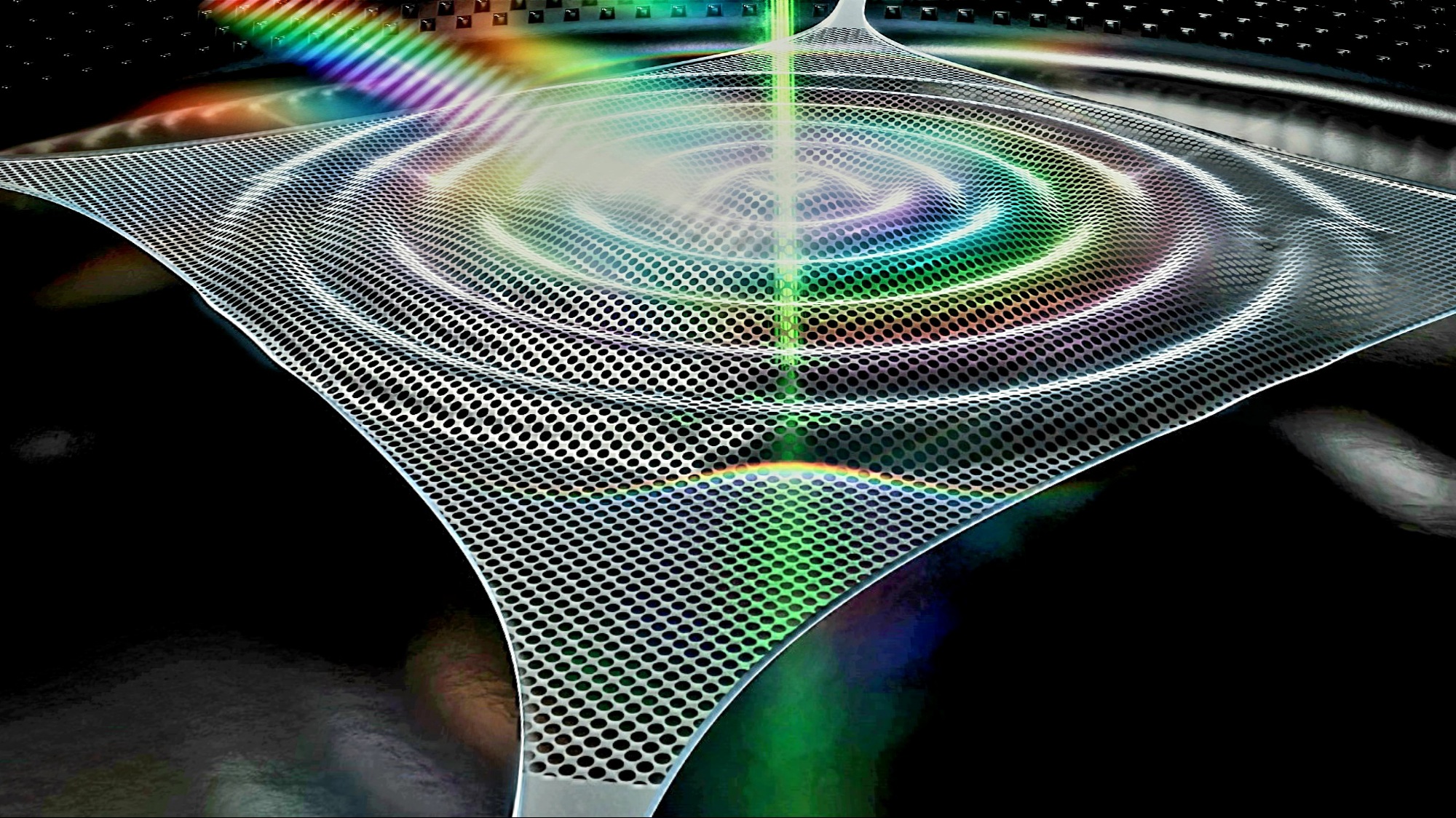

Trampoline-Shaped Sensor Uses Lasers to Detect Vibrations
Image Credit: Sciencebrush
Researchers at Delft University of Technology (Netherlands) have developed a new microchip technology that combines two Nobel Prize-winning techniques for the first time. The new technology, which uses sound vibrations instead of light, could have applications in areas such as underwater measurement and medical imaging.
The new technology is based on two unrelated Nobel Prize-winning techniques, called optical trapping and frequency combs. Optical trapping uses light to create a force that can be used to hold small particles in place. Frequency combs are a type of laser that produces a series of evenly spaced light waves.
The researchers combined these two techniques by creating a microchip with a series of tiny optical traps. When the microchip is immersed in a liquid, the frequency comb laser is used to create a sound wave that travels through the liquid. The sound wave causes the liquid to vibrate, which in turn causes the optical traps to vibrate. The vibration of the optical traps creates a force that can be used to measure the distance between the traps.
The new technology is much more precise than traditional methods for measuring distances in materials. This is because the sound waves used in the new technology can penetrate opaque materials, such as biological tissue. This makes the new technology ideal for applications such as medical imaging and underwater measurement.
The researchers believe that the new technology could have a significant impact on a wide range of fields. They are currently working to develop new applications for the technology, such as developing new medical imaging techniques and improving the accuracy of underwater navigation systems.
Potential Applications of the New Technology
The new microchip technology has the potential to be used in a wide range of applications, including:
- Medical imaging: The new technology could be used to create more detailed images of internal organs and tissues. This could lead to improved diagnosis and treatment of diseases.
- Underwater measurement: The new technology could be used to measure the distance between objects underwater. This could be used for navigation, mapping, and environmental monitoring.
- Industrial inspection: The new technology could be used to inspect the quality of manufactured goods. This could help to prevent defects and improve product safety.
- Material science: The new technology could be used to study the structure and properties of materials. This could lead to the development of new materials with improved properties.
The new microchip technology is still in its early stages of development, but it has the potential to revolutionize a wide range of fields. The researchers are currently working to develop new applications for the technology, and they are confident that it will have a significant impact on the world.
©️ Rocky Mountain Dispatch 2023
Leave a Reply