
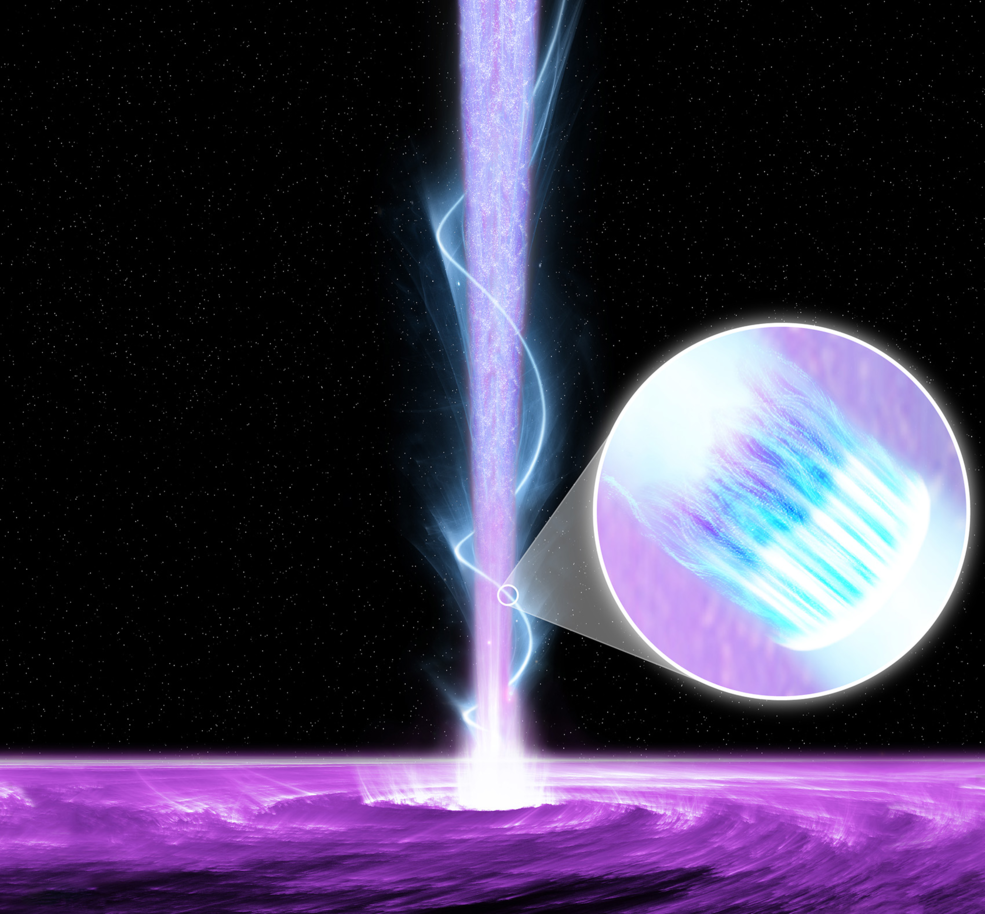

In a new study published in the journal ‘Nature’, a team of astronomers using data from NASA’s Imaging X-ray Polarimetry Explorer (IXPE) have made an exciting new discovery about blazars: they can have helical magnetic fields.
Blazars are a type of active galaxy with a supermassive black hole at their core. These black holes are surrounded by an accretion disk of hot gas, which is constantly being pulled in by the black hole’s gravity. As the gas falls in, it is heated to incredibly high temperatures, and it emits powerful jets of high-energy particles that travel at nearly the speed of light. These jets are what make blazars so bright, and they can be seen from billions of light-years away.
The new study focused on a blazar called Markarian 421, which is located in the constellation Ursa Major. IXPE’s observations of Markarian 421 revealed that the polarization of the X-ray emission from the blazar was not constant, but rather changed direction over time. This suggests that the magnetic field in the blazar’s jet is helical, meanin that it twists and turns as it travels through space.
The discovery of helical magnetic fields in blazars is a major breakthrough, as it provides new insights into how these powerful objects work. Helical magnetic fields can help to accelerate the particles in the blazar’s jet, and they can also help to generate the high-energy radiation that is emitted from the jet.
The findings of this study have the potential to revolutionize our understanding of blazars, and they could also help us to better understand other types of active galaxies. As IXPE continues to collect data, we can expect to learn even more about these fascinating objects.
In addition to the above, here are some other interesting details about the study:
- The observations of Markarian 421 were conducted over a period of three weeks in May and June 2022.
- The polarization of the X-ray emission from the blazar changed by as much as 180 degrees over the course of the observations.
- The helical magnetic field in the blazar’s jet is thought to be caused by the rotation of the black hole at the center of the galaxy.
- The discovery of helical magnetic fields in blazars could help to explain the high-energy radiation that is emitted from these objects.
This is an exciting new discovery, and it is sure to lead to further research into the nature of blazars and other active galaxies.
©️ Rocky Mountain Dispatch 2023
Leave a Reply