
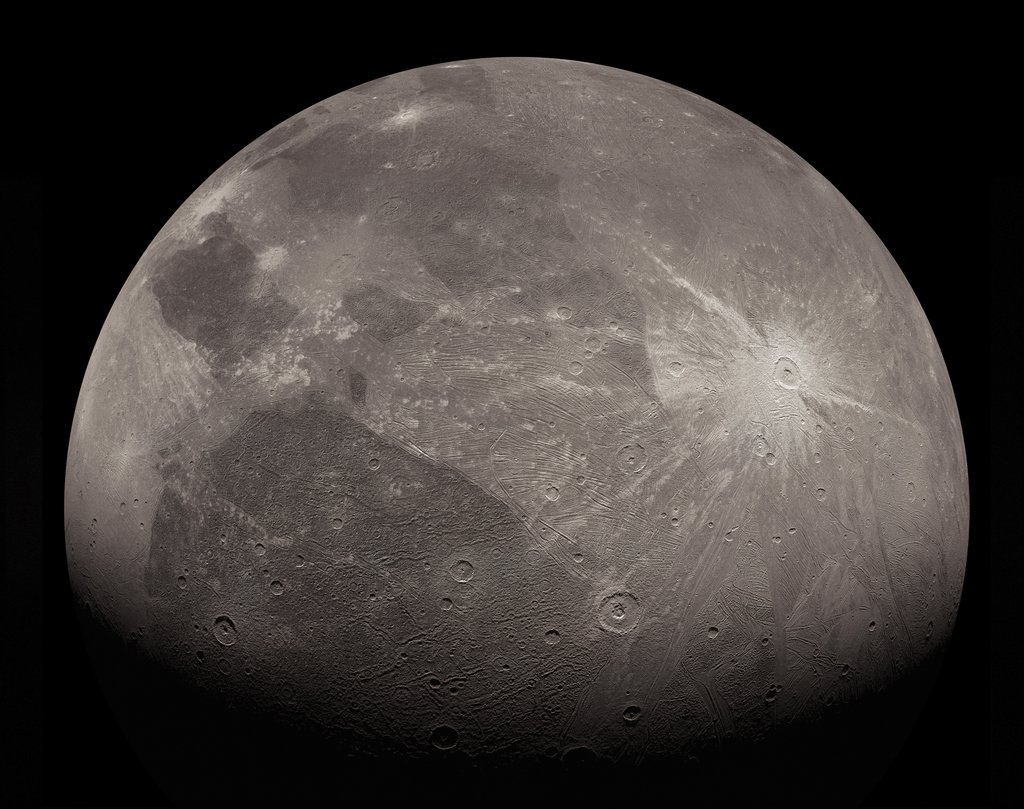

In a groundbreaking discovery, NASA’s Juno spacecraft has detected mineral salts and organic compounds on the surface of Jupiter’s moon Ganymede. This is the first time that such materials have been definitively identified on the surface of an icy moon beyond Earth, and it could have profound implications for our understanding of the habitability of these worlds.
The findings were published in the journal Nature Astronomy on October 30, 2023, and are based on data collected by Juno’s Jovian InfraRed Auroral Mapper (JIRAM) spectrometer during a close flyby of Ganymede in June 2021.
“We are thrilled to announce this discovery,” said Federico Tosi, a Juno co-investigator from the National Institute for Astrophysics in Rome, Italy, and lead author of the study. “The presence of salts and organics on Ganymede’s surface suggests that this moon may be more habitable than we previously thought.”
The salts detected by Juno include hydrated sodium chloride, ammonium chloride, and sodium bicarbonate. These salts are thought to have formed from the interaction of water and rock inside Ganymede, and they could provide a source of nutrients for any life that may exist on the moon.
The organic compounds detected by Juno are more difficult to identify, but they may include aliphatic aldehydes. These compounds are the building blocks of more complex organic molecules, including those found in living organisms.
The discovery of salts and organics on Ganymede’s surface is a major step forward in our understanding of this moon and its potential for habitability. Ganymede is already known to have a subsurface ocean that is larger than all of Earth’s oceans combined. The presence of salts and organics on the surface suggests that the ocean may also be habitable.
“This discovery is a reminder that Ganymede is a truly unique and fascinating world,” said Scott Bolton, Juno principal investigator from the Southwest Research Institute in San Antonio, Texas. “We are just beginning to explore this amazing moon, and I am excited to see what we learn in the years to come.”
Implications for Habitability
The discovery of salts and organics on Ganymede’s surface is significant for several reasons. First, it suggests that the moon’s subsurface ocean may be habitable. Salts can lower the freezing point of water, making it possible for liquid water to exist at colder temperatures. Organic compounds are also essential for life as we know it.
Second, the discovery of salts and organics on Ganymede’s surface suggests that the moon may have had a more active past than we previously thought. The salts and organics may have been formed from hydrothermal vents on the ocean floor, or they may have been brought to the surface by tectonic activity.
Third, the discovery of salts and organics on Ganymede’s surface makes the moon even more attractive as a target for future exploration. A spacecraft could land on Ganymede’s surface and collect samples of the salts and organics for analysis. This would give scientists a better understanding of the moon’s composition and its potential for habitability.
The discovery of salts and organics on Ganymede’s surface is a major milestone in our exploration of the solar system. It shows us that these icy moons may be more habitable than we previously thought, and it opens up new possibilities for future exploration.
©️ Rocky Mountain Dispatch 2023
Leave a Reply