
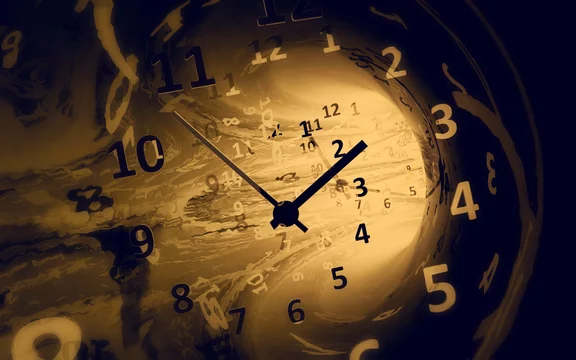

For decades, time travel has tantalized us in movies and novels, offering thrilling adventures and mind-bending paradoxes. But could it ever be more than just science fiction? New research from the University of Queensland in Australia suggests that, yes, paradox-free time travel might be theoretically possible, even with free will thrown into the mix.
Imagine zipping back to the Cretaceous period to witness dinosaurs firsthand, or perhaps stopping that infamous butterfly effect before it causes a hurricane. But then the pesky “grandfather paradox” rears its head: if you prevent your parents from meeting, how can you exist to travel back in time in the first place? This logical conundrum has long been a thorn in the side of time travel enthusiasts.
Enter Germain Tobar, a physics student who, in 2020, tackled this head-scratcher with some heavy-duty math. His calculations, published in the esteemed journal Classical and Quantum Gravity, propose a universe where space-time itself bends over backwards to avoid paradoxes.
So, let’s say you, a determined time traveler, hop back to 2020 to stop the spread of a pandemic. Tobar’s model suggests that even if you succeed in your heroic mission, the virus might find another way to emerge, perhaps through a different carrier or mutation. The point is, no matter your actions, the overall timeline remains consistent, preventing paradoxes from unraveling the fabric of reality.
Dr. Fabio Costa, Tobar’s supervisor, calls the research “the stuff of science fiction,” offering a tantalizing glimpse into a universe where free will coexists with closed time-like curves, those theoretical loops in space-time predicted by Einstein. This means you wouldn’t be confined to preordained actions in the past, but could freely explore and interact with history.
Of course, building a real-life time machine remains a colossal engineering challenge. We’re still confined to the realm of theoretical calculations, though Stephen Hawking himself believed time travel was within the realm of possibility.
If Tobar’s research holds true, it paints a fascinating picture of a universe where the past isn’t set in stone, but a dynamic tapestry that can adapt to the ripples of time travel. While paradox-free time travel might still be far-fetched, this research throws open the door to exciting possibilities. So, hold onto your flux capacitors, fellow time travel enthusiasts, the future might just be filled with the echoes of our past selves.
©️ Rocky Mountain Dispatch 2023
Leave a Reply