
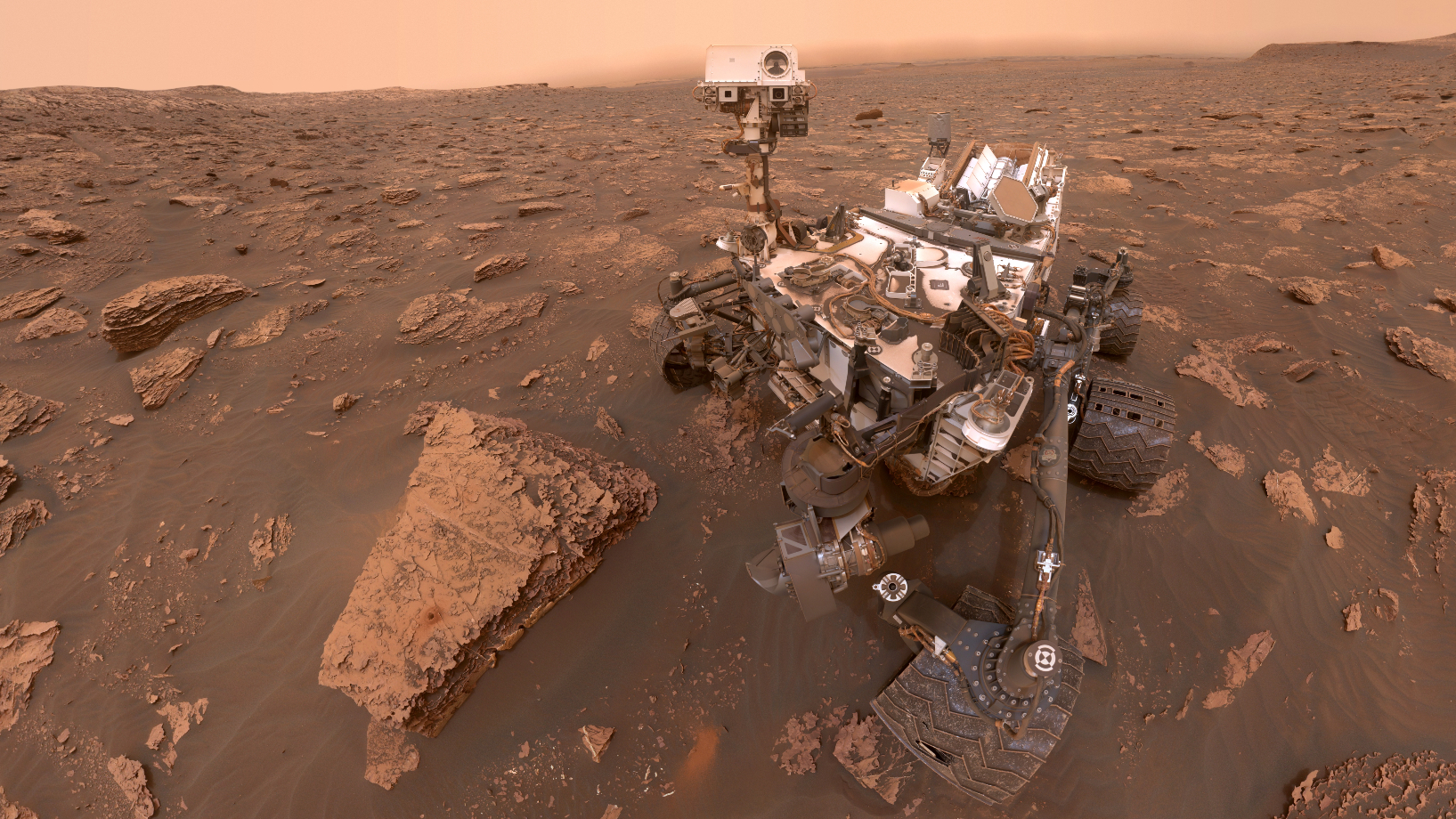
In a stunning display of scientific ingenuity, NASA’s Curiosity rover transformed itself into a celestial scribe during a recent two-week communication blackout on Mars. While Earth and Mars were aligned with the Sun, effectively severing radio contact, Curiosity embraced the silence and etched its own narrative onto the Red Planet’s surface.
Using its trusty black-and-white Hazard-Avoidance Cameras (Hazcams), Curiosity captured a mesmerizing 12-hour timelapse of its own shadow gracefully gliding across the Martian landscape. This captivating composition, meticulously stitched together from 25 individual frames, offers a breathtaking perspective on the passage of time and the celestial ballet of a Martian day.
“These shadow selfies, while unconventional, provide a truly captivating window into the daily symphony of light and shadow on Mars,” remarked Dr. Melissa Farley, a Curiosity mission scientist at NASA’s Jet Propulsion Laboratory. “They serve as a testament to the rover’s remarkable capacity for observation and documentation, even during periods of restricted communication.”
The Martian dawn serves as the opening act in this celestial choreography. Peering southeastward along Gediz Vallis, a Martian valley nestled within the majestic Mount Sharp, the Hazcam captures the first rays of sunlight gently awakening the landscape. Curiosity’s seven-foot robotic arm casts a long, elegant shadow, stretching across the frame as the sun ascends higher in the Martian sky. The rover’s front wheels, emerging from the embrace of darkness, join the dance of light, followed by the glint of its calibration target – a crucial tool for deciphering the chemical secrets of Martian rocks.
As the Martian sun reaches its zenith, the Hazcam’s exposure settings adapt to the symphony of light, revealing a crisp panorama of the surrounding terrain. However, as dusk paints the horizon with its dusky brushstrokes, the camera struggles to capture the fading light. The final frame, bathed in the ethereal glow of twilight, exhibits the telltale “hot pixels” – a testament to the camera’s valiant effort to capture the last vestiges of daylight.
While the primary objective of this timelapse wasn’t weather observation, the captured images still hold valuable scientific insights. “Even the absence of dramatic weather phenomena tells us something about the Martian atmosphere,” explained Dr. Ashwin Vasavada, Curiosity’s Project Scientist. “The subtle changes in light and shadow can inform our understanding of dust patterns and atmospheric stability.”
Beyond the scientific data, Curiosity’s Martian sundial stands as a poignant symbol of its unwavering resilience and resourcefulness. Even during periods of limited communication, it continues to push the boundaries of exploration, carving its own path through the sands of time – not just with its wheels, but with the sun-kissed etchings of its shadow.
©️ Rocky Mountain Dispatch 2023
Leave a Reply