
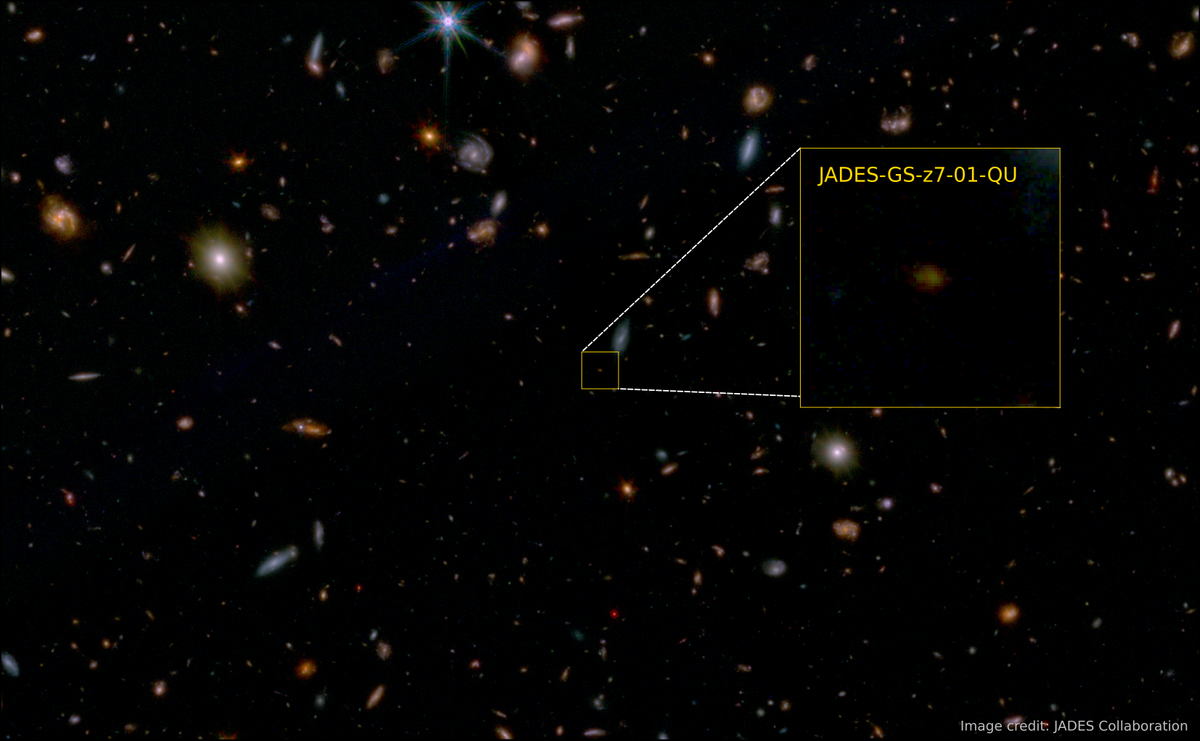

In a breakthrough that could rewrite our understanding of the early universe, astronomers have stumbled upon a ‘dead’ galaxy that existed a mere 700 million years after the Big Bang. The James Webb Space Telescope (JWST) detected this surprisingly mature relic, a finding that defies our current cosmological models.
Galaxies are dynamic systems; normally, they churn out stars for extended periods of time. However, this newly discovered galaxy appears to have shut down its star formation processes remarkably early in its life. This unexpected cessation challenges our knowledge of how galaxies evolve and could potentially force a revision of the timeline for early cosmic events.
“This discovery is like finding a fossil skeleton of a creature that was already ancient when the Earth was young,” stated Dr. Rohan Naidu, an astrophysicist at the Harvard-Smithsonian Center for Astrophysics and a leading member of the research team. “It simply shouldn’t exist according to our understanding of how the universe works.”
Precise measurements from JWST suggest that this galaxy produced stars at an astounding rate for a brief 30 to 90 million years before going dormant. The puzzle lies in what prompted this abrupt end to its star-forming activity.
Several hypotheses currently attempt to explain this phenomenon. Scientists theorize that the galaxy might have experienced intense turbulence or perhaps a supermassive black hole at its center expelled an overwhelming amount of radiation, choking off the supply of gas necessary for star formation.
“We’re in a very exciting period of discovery,” remarked Dr. Naidu. “This early galaxy provides an unprecedented glimpse into the processes at play in the young universe, demanding we refine our theories on how galaxies formed and how quickly those early structures matured.”
Future surveys with the powerful JWST are set to comb the distant universe for similar ‘dead’ galaxies. If more are found, it would bolster the case that our current cosmological models need a significant overhaul. Such findings could shed light on the mysterious processes during the universe’s infancy and reshape our perception of cosmic history.
©️ Rocky Mountain Dispatch 2024
Leave a Reply