
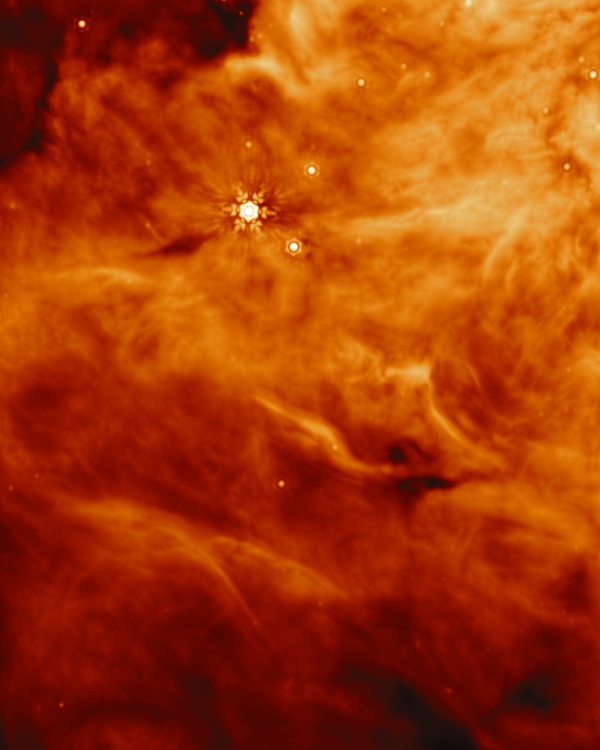

In a groundbreaking discovery, NASA’s James Webb Space Telescope (JWST) has delved into the heart of a distant, frigid molecular cloud, revealing an astonishing array of ices embedded within its depths. Among the icy cocktail, scientists have made the first-ever unambiguous detection of ethanol (the type of alcohol found in beverages), along with a host of other complex organic molecules. These findings provide unprecedented insights into the early stages of star and planetary system formation.
Precursors to a Habitable World
Dr. Will Rocha, an astronomer at NASA’s Jet Propulsion Laboratory, who led the research, explains, “This frosty region is rich with the essential ingredients of life. These molecules are the building blocks for sugars, alcohols, and even simple amino acids.” The discovery suggests that the conditions conducive to the emergence of habitable worlds might arise much earlier in the universe’s history than previously thought.
Cosmic Snowflakes
The molecules identified by JWST exist as ‘ices’ within the molecular cloud. Unlike the familiar snowflakes on Earth, these ices consist of water, methane, ammonia, and the newly-detected ethanol. The telescope’s infrared eyes allow it to peer through the obscuring dust, revealing the faint signatures of these frozen molecules.
The Chemistry of Young Stars
The molecular cloud under study is located roughly 500 light-years from Earth. It’s an active star-forming region, a stellar nursery where new stars are currently taking shape. “These ices will eventually be incorporated into new planets that form around those young stars,” says Dr. Rocha. “This delivers prebiotic molecules to the environments where life may eventually develop.”
Pushing the Boundaries of Knowledge
The extraordinary power of the James Webb Telescope continues to unveil the secrets of the universe. This latest discovery sheds light on the complex chemical processes occurring even in the coldest, darkest reaches of space. It’s a testament to human ingenuity and a bold reminder that the quest to understand our cosmic origins is far from over.
©️ Rocky Mountain Dispatch 2024
Leave a Reply