
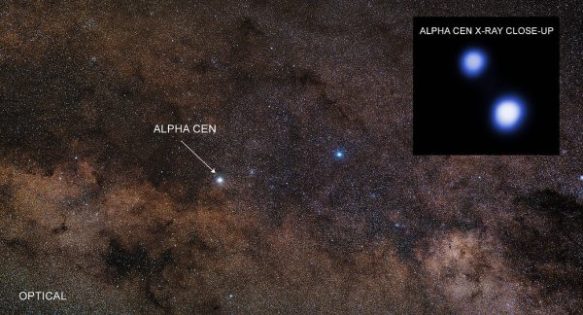

The night sky shimmers with countless stars, beacons of light scattered across the cosmic expanse. But there’s one star system that holds a special place in both astronomical study and human imagination: Alpha Centauri. Located a mere 4.37 light-years away, it’s the closest star system to our own, making it a tantalizing target for exploration and a potential signpost on the road to interstellar travel.
Alpha Centauri is not a single star, but rather a triple star system. Two of the stars, Alpha Centauri A and Alpha Centauri B, form a close binary pair, oribiting each other at a distance roughly comparable to that between the Sun and Uranus. The third member, Proxima Centauri, is a smaller red dwarf star that orbits much further out.
The Brilliance of Alpha Centauri A and B
Alpha Centauri A and B are similar to our Sun, lending an air of familiarity to this nearby system. “Alpha Centauri A is a near twin of our Sun in almost every way, including age,” states NASA, “while Alpha Cen B is somewhat smaller and dimmer but still quite similar to the Sun.” Alpha Centauri A shines with a slightly greater luminosity than the Sun, while B is a tad smaller and dimmer. To the naked eye here on Earth, they appear as a single bright star in the southern constellation of Centaurus.
Proxima Centauri: The Closest Star
Though less dazzling than its siblings, Proxima Centauri has its own claim to fame. It’s the closest star to our Sun, a faint red dwarf with an intriguing surprise: planets. At least two planets orbit Proxima. One of these, Proxima Centauri b, is Earth-sized and resides within its star’s habitable zone– the region where liquid water could exist on a planet’s surface. This discovery sparks the imagination, hinting at the potential for life beyond our solar system.
Mysteries and Potential
Alpha Centauri beckons scientists and dreamers alike. The potential for further planetary discoveries fuels the search for answers to one of humanity’s most profound questions: are we alone in the universe? Could planets orbiting Alpha Centauri A or B harbor conditions suitable for life, or even foster ecosystems of their own? As NASA notes, “Alpha Centauri may be inside the G-cloud of the Local Bubble, and its nearest known system is the binary brown dwarf system Luhman 16, at 3.6 light-years.” Exploring the immediate cosmic neighborhood of Alpha Centuari could reveal more exoplanets, or even signs of astrophysical phenomena yet to be discovered.
Despite its proximity, Alpha Centauri poses significant challenges for direct exploration. With current technology, a journey to the system would take thousands of years. Yet, projects like Breakthrough Starshot envision developing light sail technology capable of reaching Alpha Centauri within decades, bringing this fascinating star system within the realm of closer study.
Alpha Centauri serves as a reminder of the vast and awe-inspiring universe we inhabit. As we peer towards this stellar neighbor, we contemplate not only the potential for discovering life beyond Earth but also the possibilities of our own future as a spacefaring civilization. Perhaps one day, humanity will leave its footprints on the dusty plains of a world orbiting Alpha Centauri, taking those first momentous steps in our journey towards the stars.
©️ The Rocky Mountain Dispatch LLC. 2024
Leave a Reply