
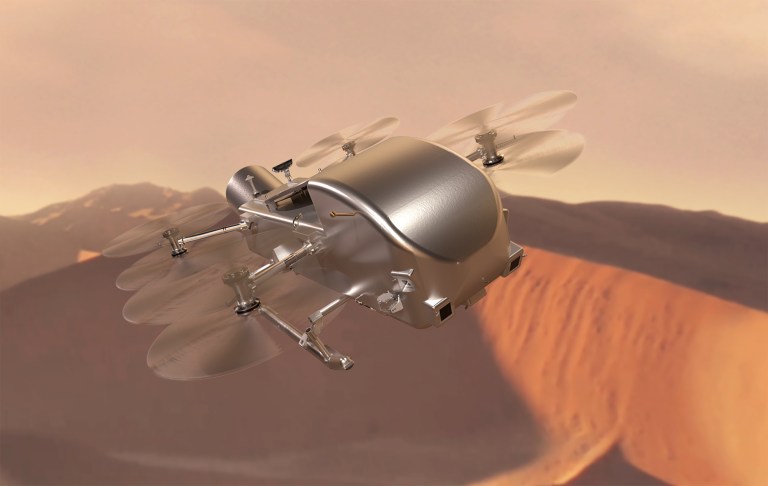

NASA is set to take a giant leap into the unknown with Dragonfly, an unprecedented mission bound for Titan, Saturn’s largest moon and a world eerily similar – yet strikingly different – from our own. Dragonfly will be a nuclear-powered rotorcraft, designed to take flight across Titan’s diverse landscape and conduct extensive studies on its unique environment.
Why Titan?
Titan stands alone in the solar system as the only moon with a dense atmosphere and stable bodies of liquid on its surface. These liquids, however, aren’t water. Titan’s rivers, lakes, and seas are filled with frigid methane and ethane, making the moon a treasure trove of prebiotic chemistry. Scientists believe this world could offer tantalizing insights into the building blocks of life and whether conditions suitable for life might exist beyond Earth.
Dragonfly’s Unique Design
Unlike rovers bound to a single landing spot, Dragonfly will leverage Titan’s low gravity and thick atmosphere to explore dozens of locations. The craft resembles a large drone with dual quadcopters, allowing for stability and maneuverability during flight.
“This is truly revolutionary,” remarked Dr. Zibi Turtle, Principal Investigator for Dragonfly from the Johns Hopkins Applied Physics Laboratory. “Titan offers a remarkable chance to explore an alien world in a way we’ve never done before.”
The Mission Plan
Dragonfly is slated for launch in 2028, with a daring arrival on Titan planned for 2034. Once there, it will embark on a multi-year journey investigating sites ranging from the methane seas to the rims of ancient impact craters. Dragonfly will carry sophisticated instruments, including spectrometers to analyze the moon’s surface composition, a drill to sample surface materials, and a suite of sensors for weather monitoring.
The Search for Life, Past or Present
While Dragonfly isn’t designed explicitly to detect life, it carries the tools to uncover tantalizing clues. The mission aims to identify complex organic molecules – the precursors to life as we know it – and investigate Titan’s potential for prebiotic chemistry. It could even help scientists understand whether life could exist in environments radically different from Earth’s.
The Challenges Ahead
The Dragonfly mission is audacious and comes with inherent risks. Titan’s environment poses significant challenges to a flying vehicle. The extreme cold, unpredictable weather patterns, and unknown terrain will push Dragonfly’s technology and engineering limits.
Yet, the potential scientific rewards are extraordinary. NASA’s Dragonfly is poised to shed light on the origins of life in our solar system and potentially change our understanding of the building blocks of the universe.
©️ The Rocky Mountain Dispatch LLC. 2024
Leave a Reply