
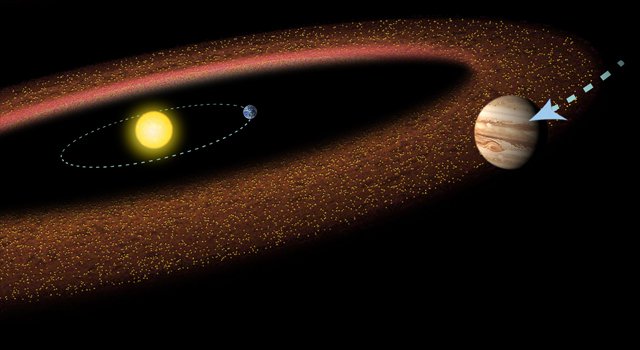
Nestled between the orbits of Mars and Jupiter lies a vast expanse of celestial debris known as the asteroid belt. This cosmic junkyard is home to millions of rocky objects, remnants from the early days of our solar system. While most asteroids reside within this belt, a few notable exceptions venture beyond its boundaries.

The asteroid belt is not a uniform ring but rather a loosely organized collection of objects ranging in size from tiny pebbles to dwarf planets like Ceres. These asteroids are predominantly composed of rock and metal, with some containing traces of water ice. They follow elliptical paths around the sun, occasionally crossing the orbits of other planets.
While most asteroids reside within the asteroid belt, some have been ejected due to gravitational interactions with larger bodies like Jupiter. These rogue asteroids can be found scattered throughout the solar system, including near-Earth asteroids that pose a potential threat to our planet.
One notable object found outside the asteroid belt is Vesta, the second-largest asteroid and one of the brightest objects in the night sky. Vesta’s unique geological features, including a massive impact crater and evidence of ancient volcanic activity, make it a fascinating target for scientific study.

Another intriguing object found outside the asteroid belt is Pallas, the third-largest asteroid and a member of the Pallas family, a group of asteroids that share similar orbital characteristics. Pallas’ unusual tilted orbit and high inclination suggest that it may have formed in a different region of the solar system than most asteroids.

The asteroid belt and its outliers offer a wealth of information about the early solar system and the processes that shaped our cosmic neighborhood. By studying these objects, we can gain a deeper understanding of our origins and the potential hazards that lurk in the depths of space.
©️ The Rocky Mountain Dispatch LLC. 2024
Leave a Reply