
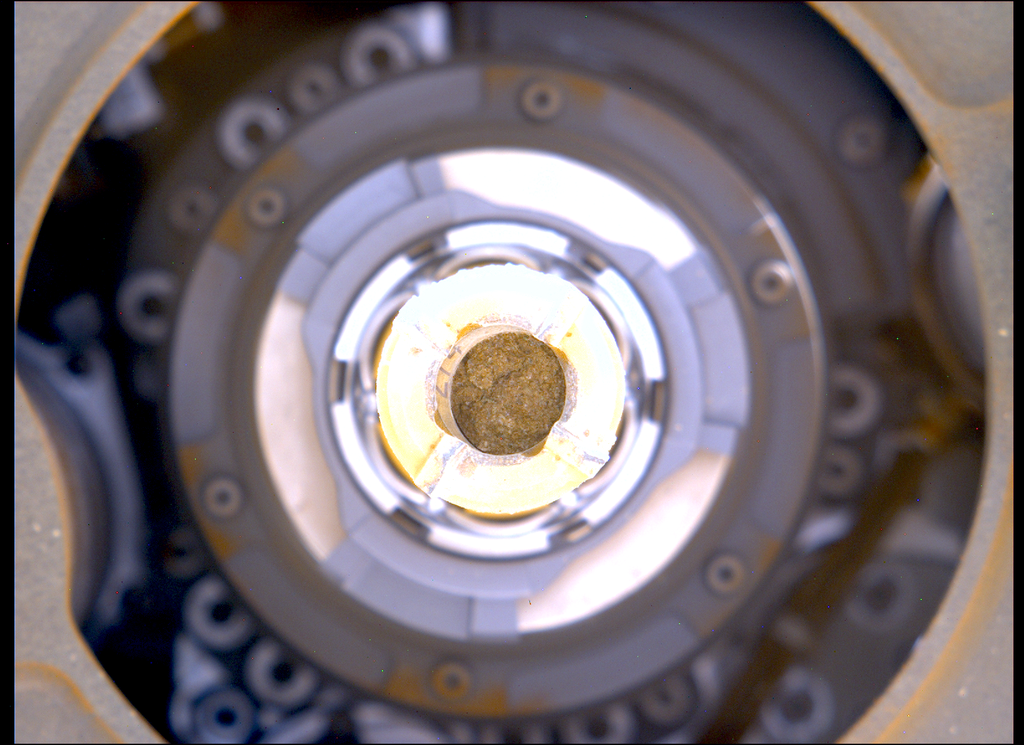

Then NASA had to deal with another untold problem: everybody has been concentrating on the Martian rocks and soil safely stored in the tubes, and Mars-chasers are seriously looking forward to bringing those precious samples back to Earth. The thing is, there’s actually more than soil and rocks inside the Sample Return tubes: there’s Martian air as well.
The Unexpected Discovery
While the rover dutifully scoops out rock-and-soil samples from Jezero Crater, the structures that hold them are sealed atop the rover mast, then prepared for shipping to Earth on future missions. Ensconced within each sample-laden tube, a couple of cubic centimeters of Martian air is now trapped. While utterly incidental to the main mission objectives, this sliver of atmosphere stands to provide an entirely unforeseen look at what Martian air actually looks like.
Challenges and Opportunities
And the presence of Martian air makes both jobs harder in two ways, too. The first problem is that it makes it harder to determine what of the collected sample comes from Martian bedrock, or sediments, and what comes from the Martian air. The second problem is that there is a risk of contamination of the samples by the Martian air that might change their state once collected.
Yet this serendipitous finding is also a great advantage: the analysis of the composition of the trapped air gives precise information about the current state of the Martian atmosphere, the evolution of its atmosphere, and the nature of the any trace gasses that might be biochemical in origin.
Implications for Future Missions
It’s a pivotal step toward answering the big-picture question of Mars’ habitability — one the presence of Martian air now seems to complicate. As always, landing on the Moon’s polar regions was one thing, but what to do next was quite another. Scientists on the Moon had an easy time learning about another rock. ‘Sample return polishes the rough “tool” we last used to transform Martian sample return from possibility to probability,’ says Michael Meyer, the lead NASA scientist for the exploration of the Moon.
A New Chapter in Mars Exploration
An in-depth inventory of Martian air trapped in the sample tubes has thrown the MSR mission into a sort of spin, which isn’t necessarily a bad thing. In fact, it adds a great deal of richness and possibility to the mission that could take off the baggage of commercial competition and push outward from the Regolith Bound Confinement sphere. If you’re willing to both bear and wield that awkward name, the Moon, Sun, and Mars Regolith Return mission is about far more than a bunch of Earthlings rushing around lodged inside a square hole, pulling up payloads in exchange for a microbial quid pro quo. The Regolith Return mission is about Mars. It’s about life, it’s about water, it’s about the cosmos in glorious, existentially Earthbound technicolor.
©️ The Rocky Mountain Dispatch LLC. 2024
Leave a Reply