
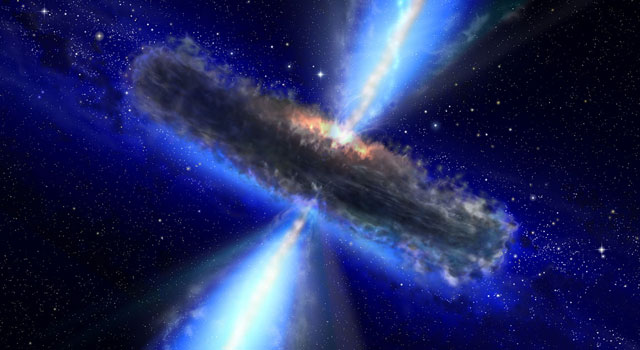

Astronomers have found an enormous water vapor cloud surrounding a supermassive black hole at the heart of a galaxy 12 billion light-years away, in our cosmic infancy, an oasis of water that’s 140 trillion times the amount in Earth’s oceans and the largest and most distant reservoir of water ever observed.
Working in two teams, the scientists, members of both the Caltech Submillimeter Observatory (CSO) and the Combined Array for Research in Millimeter-wave Astronomy (CARMA), both on the Mauna Kea mountain above sea-level observatories in Hawaii, used two enormous antennae – namely Z-Spec at the CSO and CARMA in California. The quasar at the center of the lens is noticeably luminous, a black hole 20 billion times the mass of the Sun.
We got lucky by looking at the quasar’s light spectrum and seeing the signature of water vapor – an enormous cloud of gas taking the form of water, stretching across hundreds of light-years. This gas is far colder than water lakes and seas on Earth (810 K is -53°C) but dense enough to be a significant part of the galaxy’s mass.
This finding overthrows current hypotheses about the distribution and evolution of water in the Universe by showing us that water was abundant in the early Universe, just a billion years after the Big Bang. It could transform our understanding of how galaxies and stars are formed.
“Further, we detected water – and a lot of water,” said Matt Bradford, a JPL scientist and lead author of the paper. “And this tells us that water isn’t something special about our solar system, but is part of the standard recipe of the cosmos.”
What makes the quasar’s environment unique is the fact that its water should have boiled away. The researchers think the quasar’s overwhelming radiation excites surrounding gas molecules, causing them to crash into each other and stick, forming water. That’s a lot of vapor. The reservoir must be exceptionally efficient at sucking water out of the well-exposed gas. “We might be seeing the consequence of some of the most extreme physics known to exist,” says Banados. “But apparently it can work quite well.”
This discovery paves the way for a wealth of studies on the cosmological origins and distribution of water – with these primordial reservoirs providing ideal targets for learning more about how water plays a role in galaxy evolution and exploring the possibility of life beyond our planet.
We appear to have found water so early in the history of the Universe that it could be even more abundant than we thought, meaning that it could be even more widespread throughout the cosmos, according to Bradford, which has potentially significant implications for the search for life elsewhere.
Already the teams are planning additional observations to confirm the result, and to probe the quasar’s water vapor more fully. In particular, they hope to use the Atacama Large Millimetre/submillimetre Array (ALMA), the world’s most powerful radio telescope, to map the water vapor in high detail, seeing what feedback it sends back to the black hole.
Its discovery shouldn’t just enrich our sense of water’s cosmic dimension, it will also add a new wrinkle to one of the most active debates in contemporary astronomy: what role did water actually play in the cosmos’s earliest days? How early in nature’s evolution did the need for water as a life-generator operate? And how far afield on the cosmic tree could we expect to find ourselves branching towards life?
©️ The Rocky Mountain Dispatch LLC. 2024
Leave a Reply