
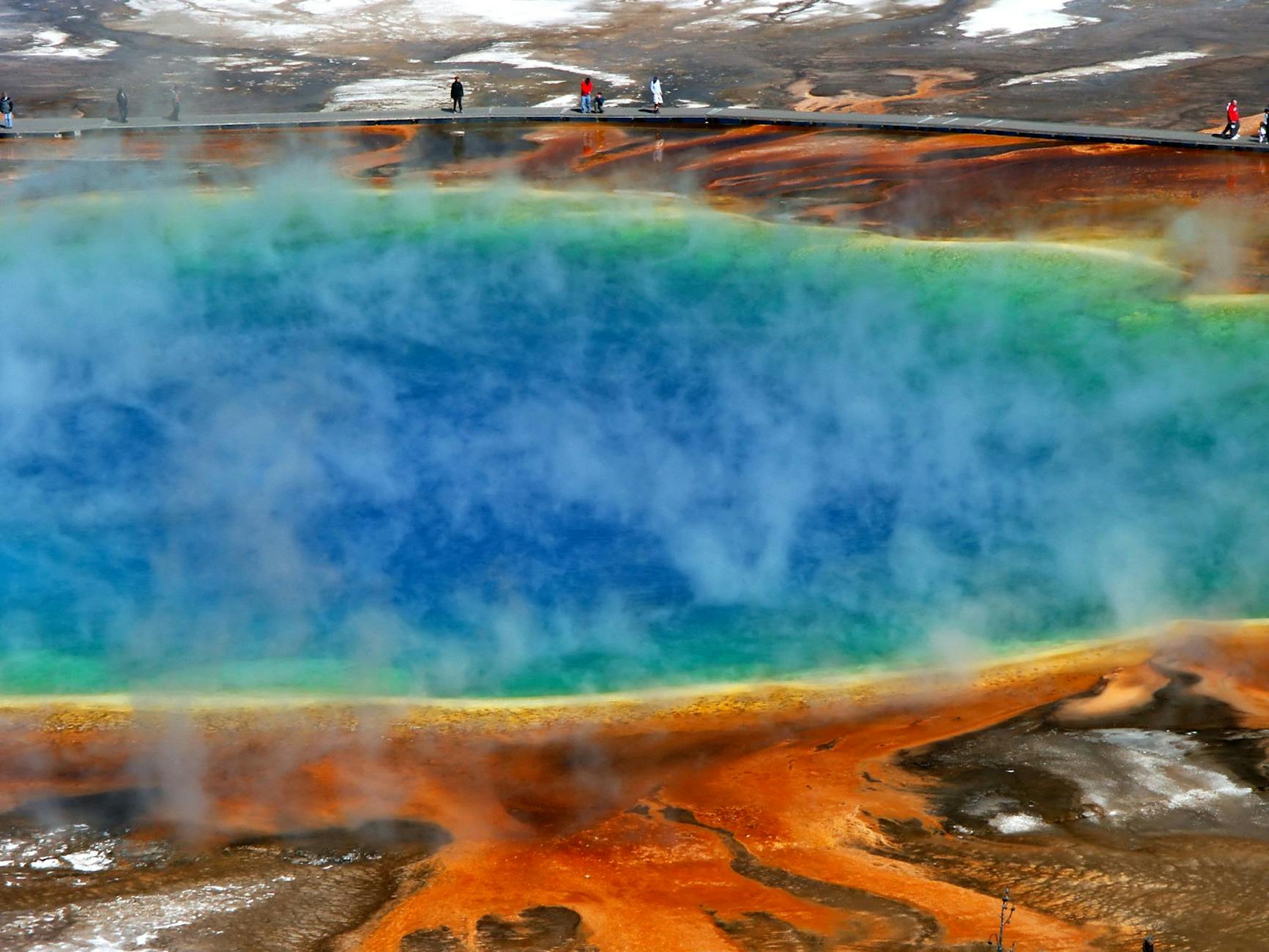

I was shocked after reading an article by Kevin Voigt, a scientific volcanologist at the Yellowstone Volcano Observatory (YVO), which included groundbreaking data about how and when Yellowstone’s supervolcano erupts. Voigt’s paper might change our understanding of volcanic hazards across much of the western US and beyond. For everyone focused on volcanic activity worldwide, the current age isn’t a millennium, but Camelian. If you’re over the age of 50, your geological era is named after you, or at least the son of your demographic cohort: we live in the Holocene, the ‘recent hot’ epoch that began with the last ice age.
For millennia now, we’ve lived in a surprisingly stable climate, at least until the Industrial Revolution warmed the climate through the emissions of ancient preindustrial carbon held in the landscape (more carbon is held in soil than all the Earth’s fossil fuels) plus a lot more carbon from Earth’s tails-end combustion of ancient fuel. Now, human activity steers the climate, possibly to our detriment. During the past 20 or so years, we’ve come to know and try to live within the Holocene. Like most periods of climate stability on Earth, it’s the greatest time in history to be alive, as long as one doesn’t fear climate change and remain indoors. As a volcanologist interested in eruptive history, I often focus on periods of volcanic activity older than the millennium I am currently experiencing.
The paper, published in the monthly Bulletin of Volcanology, reported on a study aimed at dating lava flows that have erupted between 160,000 and 70,000 years ago and showed that, contrary to past suggestions that the lava flow activity was intermittent and spread out over time and separated by holding periods, it could have all erupted together, all at the same time.
The lead author of the paper, Dr Mark Stetten of the US Geological Survey (USGS), elaborated: ‘This discovery changes our perspective of what happens to lava flows and what types of volcanic threats Yellowstone National Park face.
This study focused on the Central Plateau Member rhyolites, a series of 22 lava flows that formed in the Yellowstone Caldera at this point in time. From these rhyolites, the researchers traced five discrete episodes of eruptions, each lasting (at most) 400 years. Within each episode, eruptions from two to nine lava flows within separate vents miles apart from each other.
This revelation has significant implications.
First, it shows that intracaldera eruptions – eruptions emanating from within a caldera – are more explosive processes than we previously imagined, capable of generating multiple instantaneous vents in different areas of the caldera.
Second, if they represent five events rather than 22, the long-term rate of eruptions at Yellowstone is far lower than existing estimates, leading eruptions to be less frequent but perhaps more powerful.
As Dr Stelten warned: ‘Just because we found a new signal in this important geologic record, it doesn’t mean that Yellowstone is overdue, period. People shouldn’t panic at all. The likelihood of having a calamitous eruption is just pitifully low. This is a great healthy wonderland to visit.’
Today, the continued work of the YVO keeps an eye on Yellowstone’s volatile volcano – an effort that promises only to deepen our knowledge, and galvanise our wonder, of this complicated, majestic geologic realm.
©️ The Rocky Mountain Dispatch LLC. 2024
Leave a Reply