
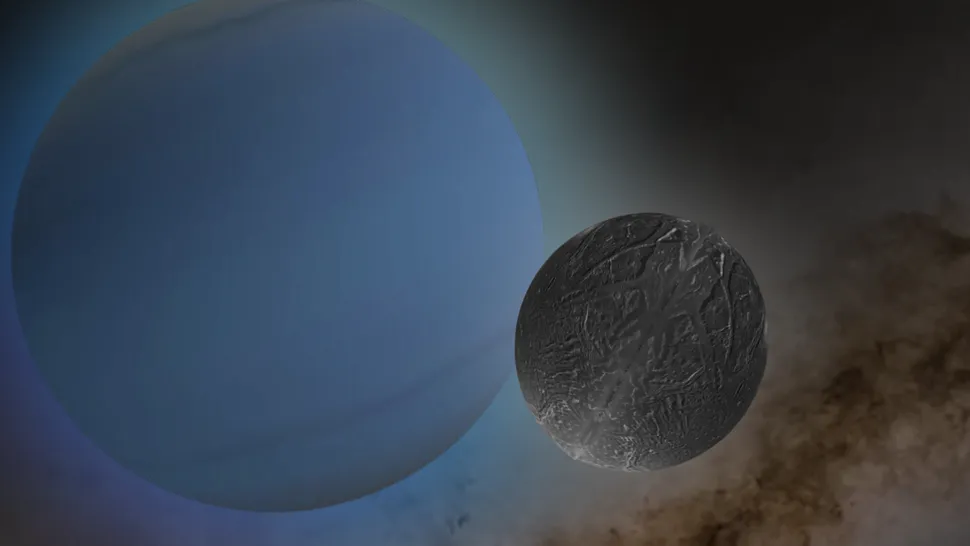

New images from the James Webb Space Telescope (JWST) have revealed convincing signs that Ariel, an icy moon of Uranus, is home to a subsurface ocean. This finding heralds the start of a new search for extraterrestrial life in the outer solar system.
While JWST detected signs for both, it found much more C02 ice than before thought on Ariel’s surface. The ice, in fact, is far more abundant on the leading hemisphere of her night side, which seems peculiar: carbon dioxide gas should not condense out at Uranus’s Distance from the Sun, and gas that did should rapidly escape into space.
Originally envisioned by a group of researchers including Richard Cartwright from the Johns Hopkins Applied Physics Laboratory to explain high abundances of carbon dioxide ice (found by the Voyagers), such a structure is likely the result of a subterranean ocean, serving as a reservoir for carbon dioxide bubbling to the surface through plumes or cracks in Ariel’s icy crust.
JWST spectroscopic data also detected another interesting molecule – carbon monoxide, which is extremely rare in icy environments. It’s difficult to see how it would make its way to the surface here, other than by being made within the interior of the moon, carried upwards due to the influence of swirling subsurface fluids.
What JWST finds will inform the search for life on planets orbiting other stars. There is mounting evidence that subterranean oceans exist on moons like Jupiter’s Europa and Saturn’s Enceladus, which are considered prime locations for extraterrestrial life because they have liquid water and sources of energy.
Additional observations of Ariel, as well as future Uranus-focused missions, are critical in confirming whether it does truly have this subsurface ocean – and then we can find out what kind of environment it would offer for life. The JWST data hint at what lies below the surface of this enigmatic icy moon, and scientists will continue to share what else they can discover from those data.
©️ The Rocky Mountain Dispatch LLC. 2024
Leave a Reply