
Deep lava tube caves might be lurking beneath the surface of the Moon Speculation for now, but plans have already been drawn up to search for such a base on the Moon’s north pole by 2020.
Unveiling the Lunar Underworld
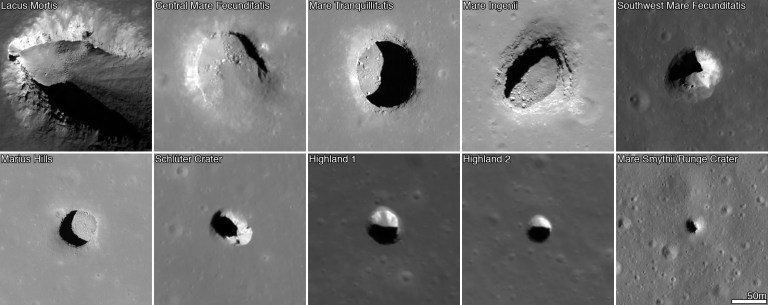
In the farside highlands, an international team of scientists has identified more than 200 pits containing hexagonal-topped pit craters using data from NASA’s Lunar Reconnaissance Orbiter (LRO). The pits vary in size from a couple of meters up to a couple of hundred meters in diameter, and have been interpreted as skylights to a deep subterranean labyrinth of collapsed lava tubes.
Lava tubes are produced as lava flows downward and outward just below the surface. As the lava at the top of the flow slowly solidifies and cools, the interior lava continues to drain away, leaving an underground tunnel behind.
A Haven for Future Explorers
But the discovery of these lunar caves has opened up a world of possibility, making the moon seem like no more hostile a place to explore than an NASA research facility. Subterranean abodes, some scientists have argued, could be superior bases for future astronauts looking to colonize the Moon. As well as having an aesthetically pleasing lunar horizon to explore, able occupants of caves could avoid the Moon’s harsh environment – its extreme temperature swings, its raining rock and radiation.
What’s more, these caves might have water ice — we don’t know for sure — and if they do, it could be a crucial ingredient for keeping a lunar outpost operating, or for refueling spacecraft that could return to the rest of the solar system.
Peering into the Depths
LRO data confirms what scientists have long suspected – the moon isn’t just a barren landscape of craters and canyons. These results come from a combination of radar and near-infrared thermal imaging that peer beneath the surface and map the extent of the cavities.
Evidence from these finds suggests that some of these caves might extend for kilometers below the Moon’s surface – but it will take further missions to see if that proves true, and to learn more about the size and nature of these lunar labyrinths.
The Next Steps
NASA and other space agencies already have planned missions. Robotic spacecraft could enter interior areas and search for signs of prebiotic molecules, ice water and even future moon base operations. Astronauts might one day explore them, too. If these discoveries lead to extensive lunar cave exploration, as truly seems possible, they open an entirely new era in the study of the Moon and our potential use of its resources and habitat.
©️ The Rocky Mountain Dispatch LLC. 2024

Leave a Reply