
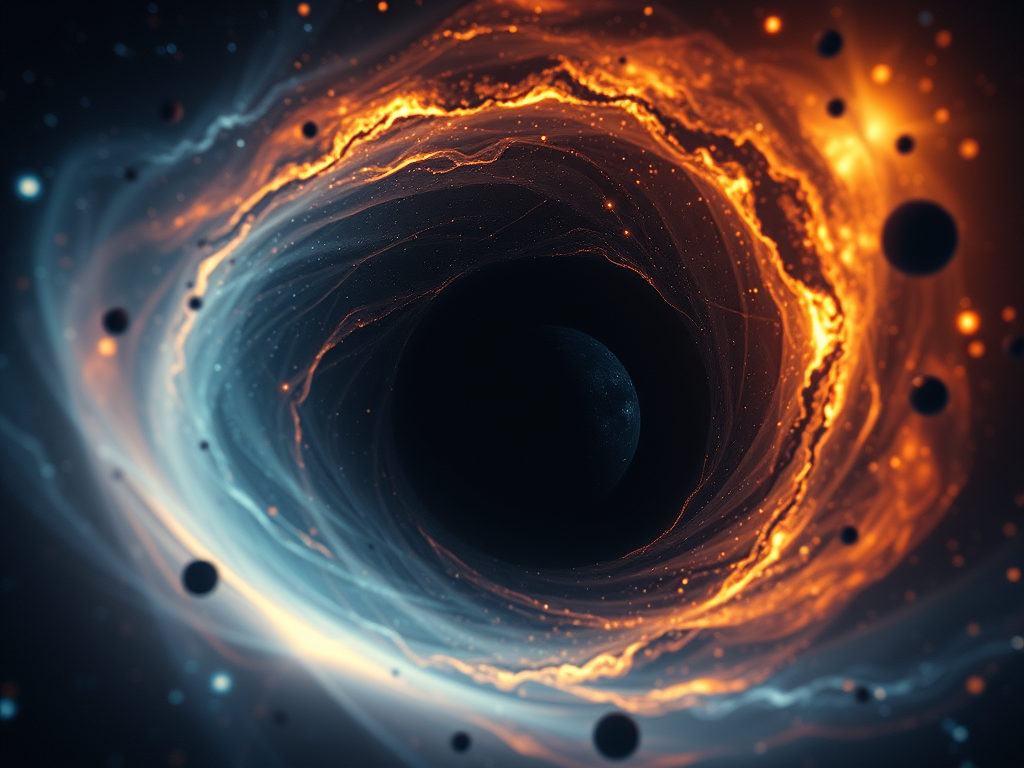

A new theory in cosmology suggests that the universe might have existed before the big bang. This theory posits that the universe went through a cycle of contraction and expansion. Black holes formed during this contraction phase could be the dark matter we see today. If this is true, it could be proven by future gravitational wave observatories.
This new theory is based on the idea that the universe is a closed system. This means that the total amount of energy and matter in the universe is always the same. If this is true, then the universe must have existed before the big bang, because the big bang created an enormous amount of energy and matter.
The new theory also suggests that the universe went through a period of contraction before the big bang. During this contraction phase, the universe became very dense and hot. Black holes could have formed during this phase.
If black holes formed during the contraction phase, they could be the dark matter we see today. Dark matter is a mysterious substance that makes up about 85% of the matter in the universe. We can’t see dark matter directly, but we can see its effects on gravity.
The new theory is still in its early stages, but it has the potential to revolutionize our understanding of the universe. If it is true, it would mean that the universe is much older than we thought, and that it has gone through a much more complex history.
Future gravitational wave observatories could help to prove or disprove the new theory. Gravitational waves are ripples in spacetime that are caused by massive objects moving around. If black holes formed during the contraction phase, they would have emitted gravitational waves. These gravitational waves could be detected by future gravitational wave observatories.
The new theory is a fascinating one, and it has the potential to change our understanding of the universe. If it is true, it would mean that the universe is much older than we thought, and that it has gone through a much more complex history.
©️ The Rocky Mountain Dispatch LLC. 2024
Leave a Reply