
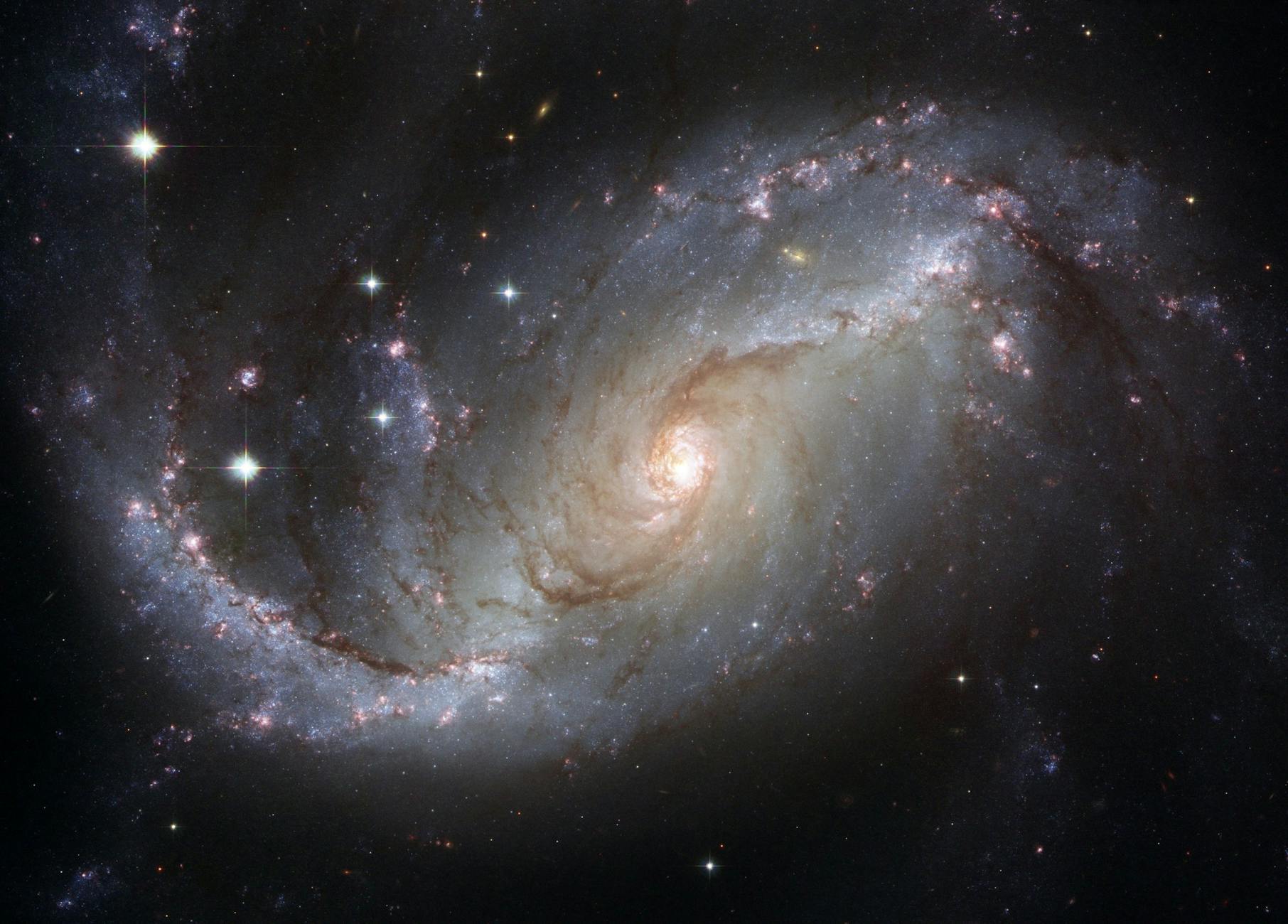

The vast expanse of the universe, with its countless stars, galaxies, and planets, is held together by a complex interplay of forces, each with its unique role. Understanding these forces is crucial to comprehending the very fabric of reality.
Gravity: The Architect of the Cosmos
Gravity, the most familiar of these forces, governs the large-scale structure of the universe. It is the attraction between objects with mass, and its strength increases with the mass of the objects involved. Gravity is responsible for the formation of stars, galaxies, and planets, as well as the orbits of planets around stars and moons around planets. Without gravity, the universe would be a chaotic collection of particles, unable to coalesce into the organized structures we see today.
Electromagnetism: The Glue of Matter
Electromagnetism is the force responsible for the interactions between electrically charged particles. It governs the behavior of atoms and molecules, and it is responsible for many everyday phenomena, such as light, electricity, and magnetism. Within atoms, the electromagnetic force binds negatively charged electrons to the positively charged nucleus, ensuring the stability of matter.
The Strong and Weak Nuclear Forces: The Heart of the Atom
The strong nuclear force is the strongest force in the universe, but it operates only at very short distances within the nucleus of an atom. It binds protons and neutrons together, overcoming the electromagnetic repulsion between protons. Without the strong nuclear force, atomic nuclei would disintegrate, and matter as we know it would cease to exist.
The weak nuclear force is responsible for certain types of radioactive decay, where one type of subatomic particle transforms into another. While less obvious in its role in holding the universe together, the weak nuclear force is crucial for the processes that power stars and create elements.
The Higgs Boson: The Key to Mass
The Higgs boson, a particle discovered in 2012, is associated with the Higgs field, an invisible energy field that permeates all of space. As particles interact with the Higgs field, they acquire mass. Without the Higgs field and the Higgs boson, all particles would be massless and travel at the speed of light, making the formation of atoms, stars, planets, and life impossible.
Dark Matter and Dark Energy: The Unseen Players
Despite our understanding of these forces, much of the universe remains shrouded in mystery. Dark matter, an invisible substance that does not interact with light, is thought to account for about 85% of the matter in the universe. Its gravitational influence is crucial for holding galaxies and galaxy clusters together.
Dark energy, a mysterious force that is causing the expansion of the universe to accelerate, is even more enigmatic. Its nature remains largely unknown, but it is thought to permeate all of space and act as a sort of anti-gravity(ish), pushing things apart.
The Balance
The universe is held together by a dynamic interplay of these forces. The attractive forces of gravity and the strong nuclear force work to bind matter together, while the expansive force of dark energy pushes things apart. The electromagnetic and weak nuclear forces play their crucial roles in the behavior of matter and the processes within stars.
The universe is a complex and fascinating place, and our understanding of the forces that govern it is constantly evolving. As scientists continue to probe the mysteries of dark matter and dark energy, we can expect to gain even deeper insights into the mysterious balance that holds the universe together.
©️ The Rocky Mountain Dispatch LLC. 2024
Leave a Reply