
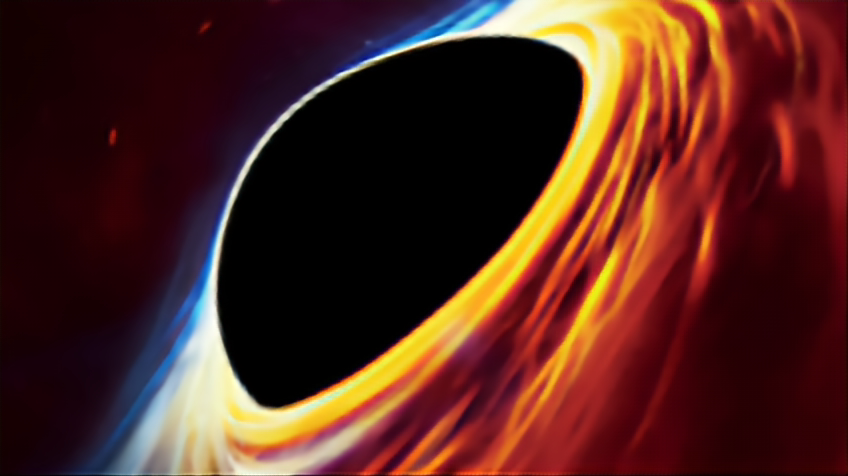

Astronomers have recently observed a fascinating phenomenon involving a supermassive black hole and its accretion disk – a swirling mass of gas and dust spiraling into the black hole. This disk has grown so large that it is causing powerful eruptions as objects orbiting the black hole collide with it. This discovery, reported in the October 9th issue of the journal Nature, provides valuable insights into the dynamics of black holes and their surrounding environments.
The research focused on quasi-periodic eruptions (QPEs) – bursts of X-rays that repeat at regular intervals. Scientists used data from NASA’s Chandra X-ray Observatory and other telescopes to study these QPEs. They found that the accretion disk around a particular black hole had expanded significantly, leading to collisions with orbiting objects and causing the observed X-ray bursts.
“It’s like a cosmic demolition derby,” explained one of the researchers involved in the study. “These objects are crashing into a wall of superheated material, creating incredibly powerful shockwaves and X-ray flares.”
This finding links QPEs to tidal disruption events (TDEs), where stars are torn apart by the black hole’s gravity. The remnants of these stars form the accretion disk, which continues to grow over time.
The discovery also has implications for the search for gravitational waves – ripples in spacetime caused by the acceleration of massive objects. The collisions between orbiting objects and the accretion disk are expected to generate gravitational waves, which could be detected by future observatories.
“These eruptions could be a treasure trove for gravitational wave astronomers,” said another researcher. “By studying these events, we can learn more about the nature of gravity and the behavior of black holes in extreme environments.”
The team is now working to identify more QPEs associated with TDEs. By measuring their frequency and distances, astronomers can better understand the behavior of objects around supermassive black holes. This information will be crucial for optimizing future gravitational wave observatories and unlocking the secrets of these cosmic phenomena.
©️ The Rocky Mountain Dispatch LLC. 2024
Leave a Reply