
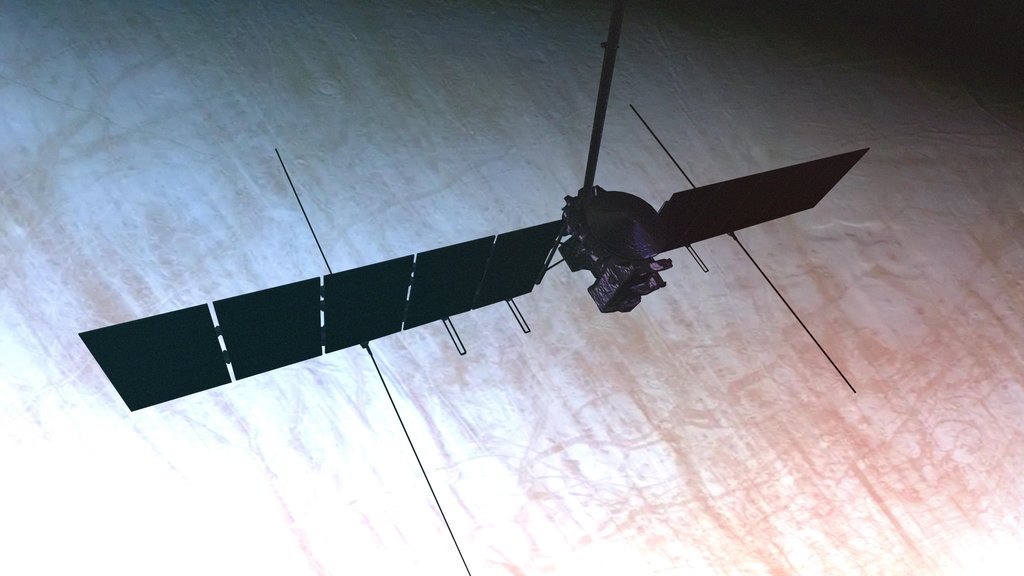

In the vast expanse of our solar system, Jupiter’s moon Europa beckons with its icy secrets. Beneath its frozen surface lies a hidden ocean, a realm that scientists believe could harbor the ingredients for life. NASA’s Europa Clipper, a spacecraft on a pioneering mission, is steadily progressing on its 1.8-billion-mile journey to unlock these mysteries.
Launched on October 10th, 2024, Europa Clipper is a marvel of engineering, equipped with a suite of sophisticated instruments designed to probe Europa’s subsurface ocean. The spacecraft recently achieved a crucial milestone with the successful deployment of its magnetometer boom on November 14th, 2024, marking a significant step towards its 2030 rendezvous with Jupiter.
This 10-foot boom, a key component of the magnetometer instrument, will play a pivotal role in measuring the strength and direction of Europa’s magnetic field. These measurements will provide valuable insights into the depth and salinity of the moon’s subsurface ocean, helping scientists determine its potential habitability.
“The deployment of the magnetometer boom is a testament to the ingenuity and dedication of the Europa Clipper team,” said Dr. Robert Pappalardo, the mission’s project scientist at NASA’s Jet Propulsion Laboratory (JPL) in Southern California. “This instrument will be our eyes and ears beneath Europa’s icy shell, allowing us to peer into a world that has remained hidden for eons.”
Europa Clipper’s journey is not without its challenges. The spacecraft, being developed by Johns Hopkins University Applied Physics Laboratory (APL) in Maryland, must withstand the harsh radiation environment of Jupiter and navigate the complex gravitational forces of the gas giant and its moons. However, the mission team is confident that Europa Clipper will overcome these hurdles and deliver groundbreaking scientific discoveries.
“We are pushing the boundaries of space exploration with Europa Clipper,” said Dr. Jordan Evans, the mission’s deputy project scientist at JPL. “This mission has the potential to revolutionize our understanding of the potential for life beyond Earth.”
Upon reaching Jupiter in 2030, Europa Clipper will embark on a series of 49 flybys of Europa, each time gathering crucial data about the moon’s surface, composition, and interior. The spacecraft’s instruments will map the icy shell, analyze the moon’s tenuous atmosphere, and search for plumes of water vapor that may erupt from the subsurface ocean.
The data collected by Europa Clipper will be analyzed by scientists around the world, eager to unravel the secrets of this enigmatic moon. Could Europa harbor life? The answer to this profound question may lie within the grasp of this ambitious mission.
©️ The Rocky Mountain Dispatch LLC. 2024
Leave a Reply