
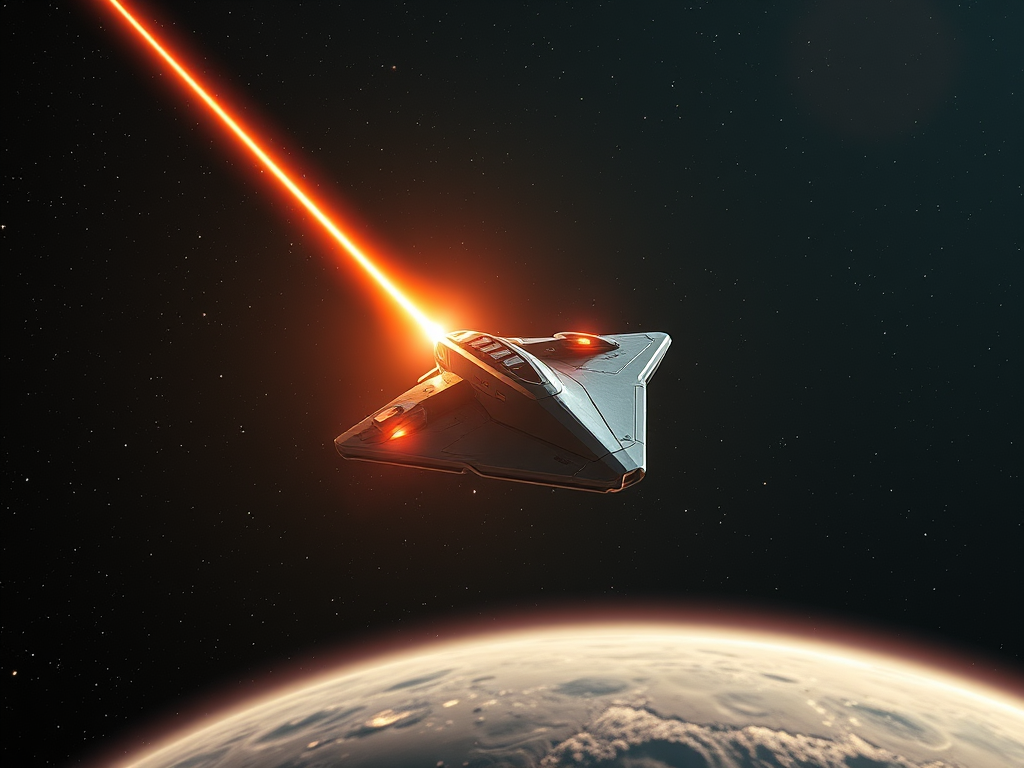

A Novel Approach to Interstellar Travel
Scientists have long envisioned interstellar travel, but the vast distances between stars pose a significant challenge. Traditional propulsion methods, such as chemical rockets, are inadequate for traversing these immense distances within a human lifetime. As a result, researchers have explored alternative propulsion concepts, including beam-powered propulsion, which involves propelling a spacecraft using energy from a remote source.
Limitations of Current Beam-Powered Propulsion Methods
Beam-powered propulsion concepts typically involve using lasers or microwaves to push a spacecraft. However, these methods have limitations, including high power requirements and limited range. For instance, the Breakthrough Starshot project, which aims to send a probe to Alpha Centauri, our nearest star system, envisions using a massive laser array with a range of approximately 0.1 astronomical units (AU). This limited range necessitates rapid acceleration to achieve interstellar cruise velocity before the spacecraft leaves the beam’s reach.
Overcoming Range Limitations with Relativistic Electron Beams
To address the range limitations of current beam-powered propulsion methods, researchers have proposed using relativistic electron beams. These beams consist of electrons traveling at near-light speed, and their relativistic properties can significantly reduce the effects of space charge, which typically causes beams to expand rapidly. By utilizing relativistic electron beams, it becomes possible to transmit energy over distances much greater than those achievable with lasers or microwaves.
Advantages of Relativistic Electron Beams
Relativistic electron beams offer several advantages for interstellar propulsion. Firstly, they can propagate over long distances, potentially reaching hundreds or even thousands of AU. This extended range reduces the power requirements for the beam transmitter and allows for more gradual acceleration of the spacecraft. Secondly, relativistic electron beams can be generated using space-based infrastructure, such as a statite, which is a spacecraft that maintains a fixed position relative to the Sun. This eliminates the need for a massive ground-based infrastructure and enables continuous beaming of energy to the spacecraft.
Challenges and Future Directions
While relativistic electron beams offer a promising avenue for interstellar propulsion, several challenges need to be addressed before they can be realized. One challenge is the interaction of the beam with magnetic fields in space, which could deflect the beam and hinder its effectiveness. Further research is needed to understand and mitigate these effects. Another challenge is the reception and conversion of the beam’s energy into a usable form for propulsion. Scientists are exploring various methods, including electromagnetic reflection and direct non-thermal rocket conversion, but further development is required.
Despite these challenges, relativistic electron beams hold the potential to revolutionize interstellar travel. Their ability to transmit energy over long distances could pave the way for more practical and efficient interstellar missions, opening up new frontiers in space exploration.
©️ The Rocky Mountain Dispatch LLC. 2025
Leave a Reply