
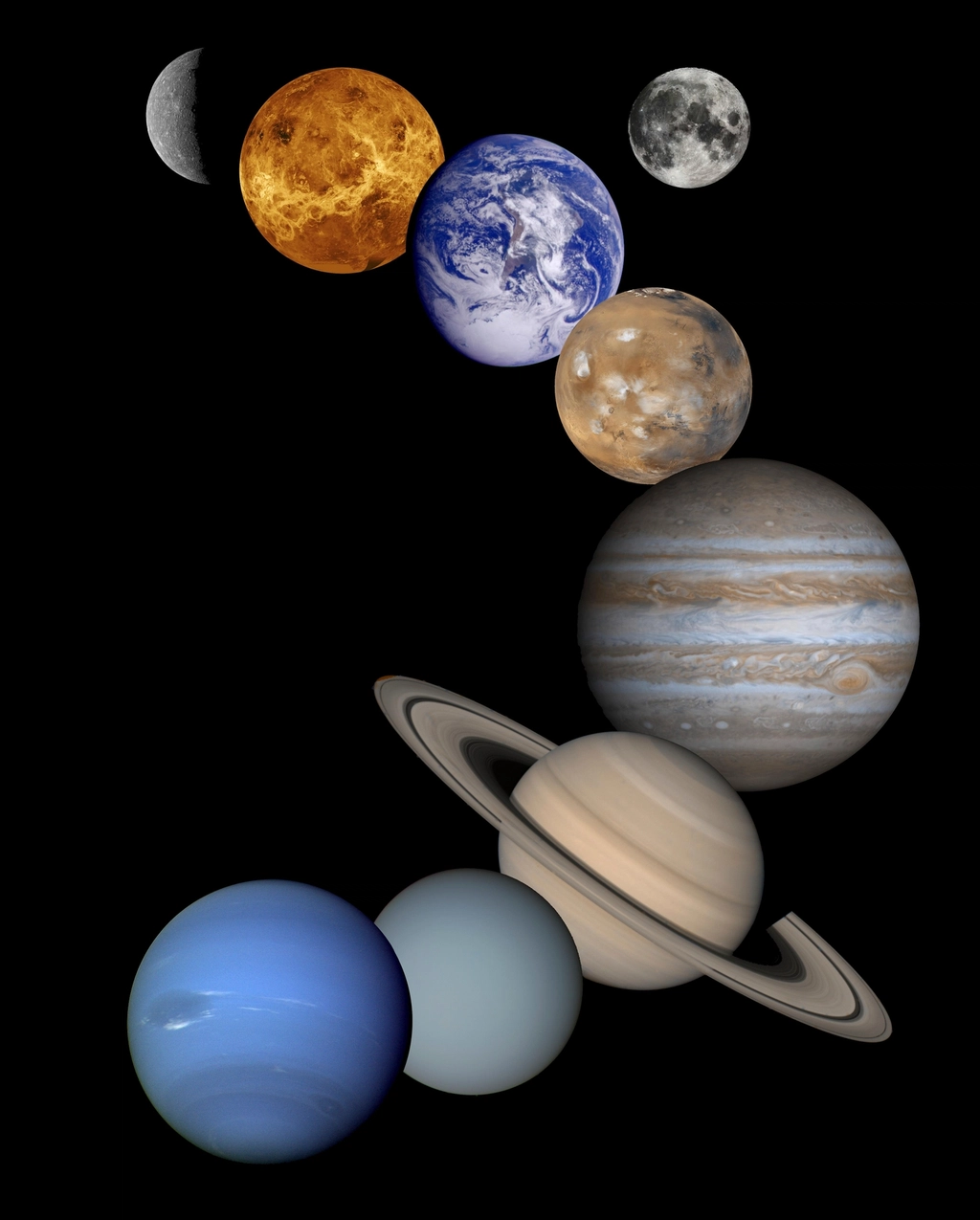

A new study suggests that a close encounter with a substellar object in the early solar system could explain the current configuration of the giant planets.
The orbits of Jupiter, Saturn, Uranus, and Neptune are not perfectly circular nor perfectly aligned with the plane of the solar system. This has long puzzled astronomers, as the planets are thought to have formed from a rotating disk of gas and dust that would have produced well-behaved orbits.
A new study published in the journal Astronomy and Astrophysics offers a possible explanation: a flyby of a substellar object – an object more massive than Jupiter but not massive enough to ignite nuclear fusion and become a star.
The researchers, led by Garett Brown of the University of Toronto at Scarborough, used computer simulations to show that a single encounter with a 2 to 50 Jupiter-mass object could have excited the eccentricities and inclinations of the giant planets to their current values.
The flyby would have had to occur within the first 100 million years of the solar system’s history, when the planets were still embedded in a gaseous disk. The object would have passed through the solar system at a perihelion distance of less than 20 astronomical units (AU) – 20 times the distance between Earth and the Sun.
The researchers estimate that there is about a 1-in-100 chance that such a flyby would produce a dynamical architecture similar to that of the solar system.
“This is not a negligible probability,” said Brown. “Given that there are estimated to be billions of Sun-like stars in the Galaxy, and that stars are commonly formed in open star clusters, it is quite possible that a flyby like this has happened to other planetary systems.”
The researchers also found that the flyby would have had little effect on the inner solar system, including Earth.
“This is good news for us,” said Brown. “A flyby like this would not have been catastrophic for Earth, and in fact it may have even played a role in the delivery of water to our planet.” The researchers’ simulations also showed that the flyby could have excited the eccentricities and inclinations of the minor planets in the asteroid belt and the trans-Neptunian region.
“This could explain the observed orbital distribution of these objects,” said Brown.
The researchers’ findings suggest that substellar flybys may be an important factor in the evolution of planetary systems. “We need to take substellar flybys into account when we study the formation and evolution of planetary systems,” said Brown.
©️ The Rocky Mountain Dispatch LLC. 2025
Leave a Reply