
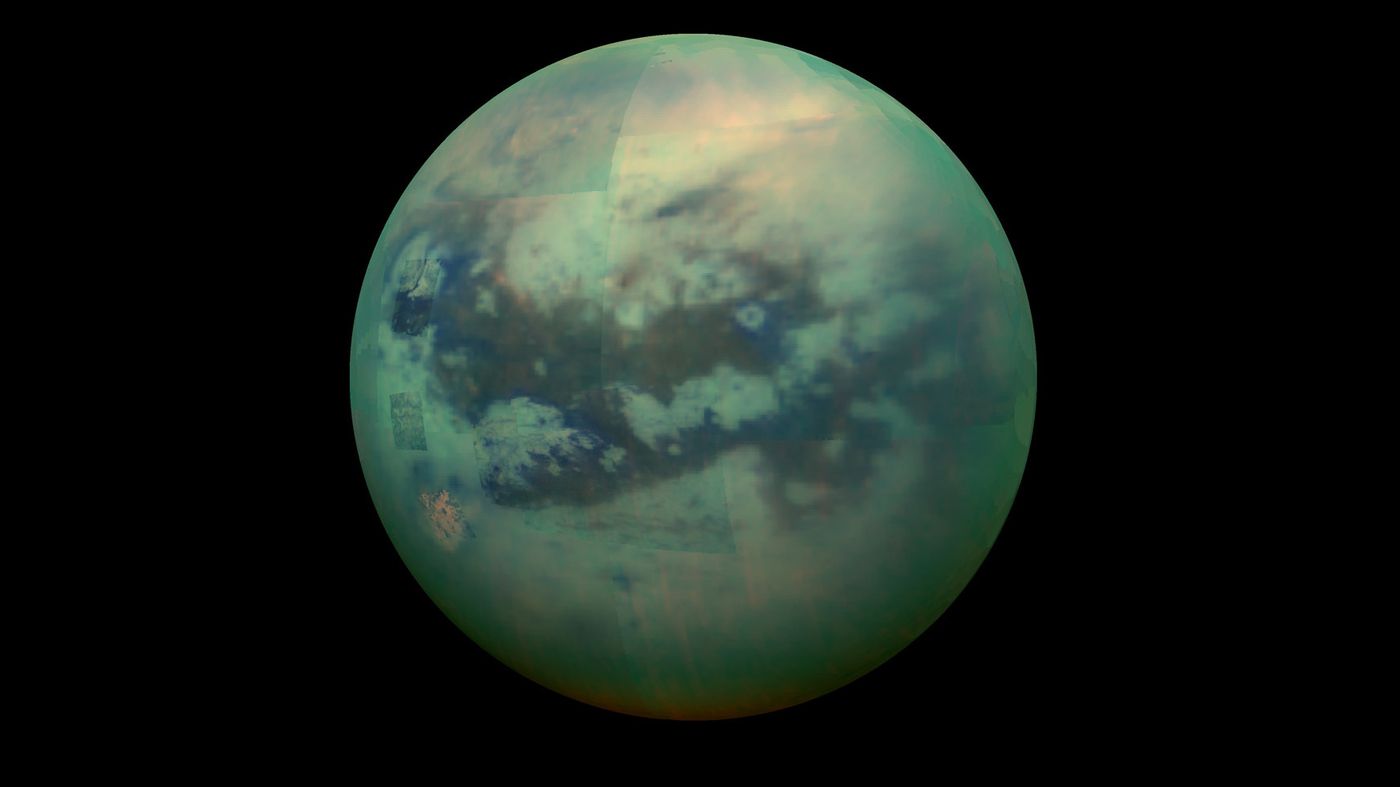

This summer, the cosmos treats us to a rare and mesmerizing performance: Titan, Saturn’s largest and most mysterious moon, is casting giant shadows across the gas giant’s sprawling rings. These fleeting silhouettes are only visible when Saturn’s orbit and tilt align perfectly—something that won’t happen again until 2040.
As sunlight filters through the icy particles of Saturn’s rings, Titan’s broad form moves into view, blocking beams of light like a curtain sliding across a glittering stage. Earth-based telescopes and orbital observatories, like the James Webb Space Telescope, are capturing high-resolution images of the event, revealing subtle ring textures and minute changes in color and density.
For planetary scientists, this isn’t just a visual delight—it’s a data goldmine. The way light bends, scatters, or disappears behind Titan helps researchers refine models of the rings’ composition, age, and even gravitational structure. These moments also fine-tune our understanding of Titan’s trajectory, mass, and the gravitational waltz it performs with Saturn and its other moons.
“It’s like using a shadow puppet to understand the shape of a hand,” explains Dr. Kimara Voss, a planetary dynamicist. “Every pass helps us piece together Saturn’s story.”
🪐 Titan: Saturn’s Moon and the Key to Alien Chemistry?
NASA’s highly anticipated Dragonfly mission is revving up to explore a truly alien frontier: Titan, Saturn’s massive moon cloaked in a dense orange haze and dotted with liquid hydrocarbon lakes. Set to launch next year, Dragonfly will deploy an octocopter drone capable of hopping across Titan’s surface, analyzing chemical signatures and searching for the building blocks of life.
What makes Titan so compelling isn’t just its size—it’s the chemistry. Beneath its icy crust and within its methane-rich rivers, Titan hosts organic compounds that closely resemble the precursors to life on early Earth. Recent flyby data from Cassini and Huygens hinted at the presence of tholins, acetylene, and complex carbon chains. The Dragonfly mission will investigate how these molecules interact in Titan’s uniquely frigid environment, offering a rare window into prebiotic chemistry.
Despite temperatures that plunge below -290°F, Titan’s geologically active surface—marked by dunes, cryovolcanoes, and shifting lakes—may harbor key processes that echo those that once sparked life on Earth.
“It’s a natural chemistry lab with the knobs set to alien,” says Dr. Lani Ortega, a chemist on the mission. “The more we learn, the more Titan becomes a mirror to our planet’s earliest moments.”
©️ The Rocky Mountain Dispatch LLC. 2025
Leave a Reply