
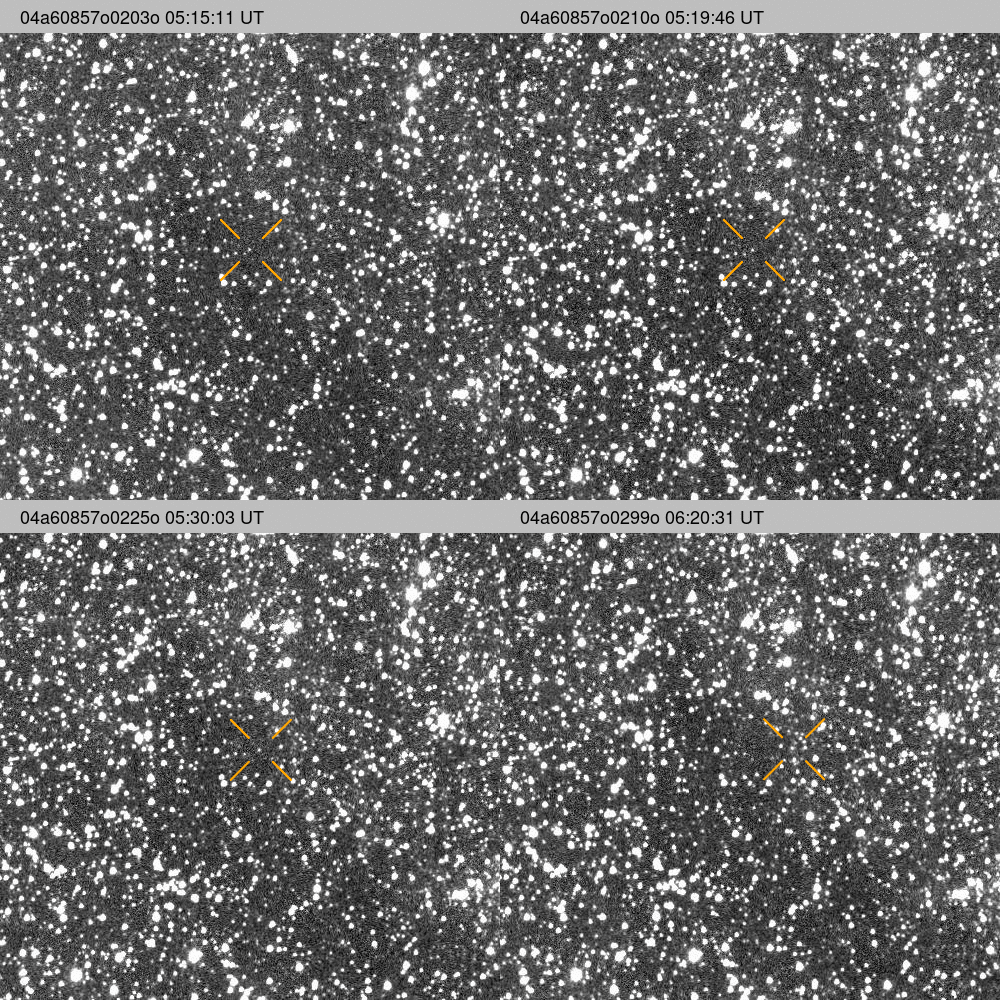
Astronomers have confirmed the arrival of a rare and extraordinary object: Comet 3I/ATLAS, the third known interstellar visitor to enter our solar system. First detected on July 1, 2025, by the ATLAS telescope in Chile, this fast-moving comet is not bound by the Sun’s gravity and is traveling on a hyperbolic trajectory that confirms its origin beyond our solar system. Its discovery marks a significant milestone in the study of planetary formation and interstellar chemistry.
Comet 3I/ATLAS follows two previous interstellar objects: 1I/ʻOumuamua, discovered in 2017, and 2I/Borisov, identified in 2019. Unlike its predecessors, 3I/ATLAS is both larger and faster. Early estimates suggest it spans between 15 and 20 kilometers in diameter and is traveling at approximately 152,000 miles per hour. Its trajectory and speed indicate that it is not gravitationally bound to the Sun and will eventually exit the solar system.
What makes 3I/ATLAS particularly valuable to scientists is the opportunity for extended observation. Unlike ʻOumuamua, which was discovered after its closest approach to the Sun, 3I/ATLAS was identified early enough to allow months of detailed study. This includes chemical analysis of its coma—the cloud of gas and dust surrounding the comet’s nucleus—as it becomes more active during its approach to the Sun.
Preliminary spectroscopic data reveal that 3I/ATLAS has a reddish hue and contains organic molecules, possibly including amino acids and hydrocarbons. Its spectral slope in the visible and near-infrared range is consistent with D-type asteroids and primitive comets, suggesting a composition rich in carbon-based compounds. Scientists believe the comet originated in the thick disk of the Milky Way, a region populated by older stars. This implies that 3I/ATLAS may be between eight and ten billion years old, making it a primordial relic from a distant planetary system.
To understand the significance of this discovery, it is helpful to compare 3I/ATLAS with its predecessors. The first interstellar object, 1I/ʻOumuamua, was an enigma. It showed no signs of a coma or outgassing, yet it exhibited non-gravitational acceleration. This led to a range of hypotheses, including radiation pressure, sublimation of molecular hydrogen ice, and even speculation that it might be an alien probe. Most scientists now favor natural explanations, though its exact nature remains unresolved.
The second object, 2I/Borisov, was more typical in appearance and behavior. It displayed a visible coma and tail, and its chemical composition included unusually high levels of carbon monoxide—between nine and twenty-six times more than any solar system comet observed at similar distances. This suggests that Borisov may have formed in a cold, carbon-rich region around a red dwarf star. It also contained hydrogen cyanide in typical amounts, reinforcing the idea that it originated in a distant and chemically distinct planetary system.
Comet 3I/ATLAS builds on these discoveries by offering a more chemically active and observable specimen. Its large size and early detection allow for coordinated observations using Earth-based telescopes, Mars orbiters, and the James Webb Space Telescope. Scientists hope to analyze its coma in detail during its closest approaches to Mars in early October and to Earth in mid-December.
The arrival of 3I/ATLAS also supports emerging theories about the frequency and nature of interstellar objects. Many astrophysicists now believe that such objects are ejected debris from planetary systems during their early formation stages. These fragments, no longer bound to their parent stars, drift through the galaxy and occasionally pass through our solar system. They serve as chemical fossils, preserving the conditions of their birth environments and offering rare insights into planetary diversity across the Milky Way.
Comet 3I/ATLAS is expected to reach its closest point to the Sun on October 30, 2025, and its closest approach to Earth on December 19, 2025, at a distance of approximately 1.6 astronomical units. During this time, scientists anticipate increased cometary activity, including brightening and gas release, which will enhance opportunities for chemical analysis.
In conclusion, Comet 3I/ATLAS is more than a fleeting visitor—it is a messenger from a forgotten corner of the galaxy. As it sheds its icy layers under the Sun’s warmth, it offers scientists a rare chance to decode the chemistry of alien worlds. Whether it is simply a fast-moving rock or a relic of cosmic history, its journey reminds us how much we still have to learn about the universe and how fortunate we are to witness such events.
©️ The Rocky Mountain Dispatch LLC. 2025
Leave a Reply