
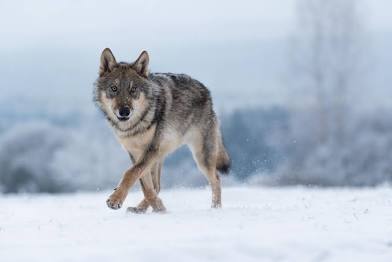

In a landmark decision for wildlife conservation, Senior U.S. District Judge Donald Molloy ruled that the U.S. Fish and Wildlife Service (USFWS) violated the law when it denied Endangered Species Act (ESA) protections for gray wolves in the Northern Rocky Mountains. The ruling stems from a lawsuit filed by four leading conservation organizations: the Center for Biological Diversity, Humane World for Animals, Humane World Action Fund, and the Sierra Club.
Background: A Decade of Controversy
Gray wolves were delisted from federal protection in the Northern Rockies in the early 2010s, transferring management to states like Idaho, Montana, and Wyoming. Since then, aggressive state policies have led to widespread wolf killing:
– Idaho permits unlimited wolf-killing tags, allows killing with hounds and ATVs, and offers bounties disguised as reimbursements.
– Montana legalized baiting and strangulation snares, with proposals allowing individuals to kill or trap up to 30 wolves per season.
– Wyoming classifies wolves as “predatory animals,” allowing unrestricted killing across most of the state.
These policies have drawn fierce criticism from scientists and conservationists, who argue they threaten the genetic health and long-term viability of wolf populations.
The Court Case: Humane World Action Fund et al. v. USFWS
The plaintiffs filed a legal petition in May 2021 urging the USFWS to restore protections. Although the agency launched a review, it ultimately denied the petition in February 2024—even after acknowledging that state-sanctioned wolf killing could reduce the population from 2,534 to as few as 667 wolves.
Judge Molloy’s ruling found multiple legal and scientific flaws in the USFWS’s decision:
– Failure to consider unoccupied but suitable habitat in the western U.S., including the southern Rockies.
– Dismissal of Colorado’s growing wolf population, which has expanded through natural dispersal and reintroduction.
– Reliance on flawed population estimates from Idaho and Montana, ignoring scientific critiques.
– Neglect of genetic threats from small, isolated populations.
– Incorrect assumptions about population connectivity despite high mortality rates.
The ruling vacates the agency’s 2023 denial and requires a formal reconsideration of protections for wolves in Idaho, Montana, Wyoming, and parts of Washington, Oregon, and Utah.
Ecological Importance of Wolves
Wolves are apex predators and keystone species. Their presence regulates prey populations, restores vegetation, and supports biodiversity. In Yellowstone National Park, wolf reintroduction famously led to trophic cascades that revitalized entire ecosystems.
“Wolves are deeply intelligent, social animals who play an irreplaceable role in the ecosystems they call home,” said Kitty Block, president of Humane World for Animals.
What’s Next?
The USFWS has 60 days to decide whether to appeal the ruling. If upheld, the decision could reinstate federal protections and reshape wolf recovery across the West—including in Colorado, where wolves are beginning to reclaim historic territory.
“This ruling is a turning point,” said Collette Adkins of the Center for Biological Diversity. “Recovery requires that wolves return to places like the vast southern Rockies, where they once lived. They can thrive there if they have the lifesaving protections of the Endangered Species Act.”
©️ The Rocky Mountain Dispatch LLC. 2025
Leave a Reply