
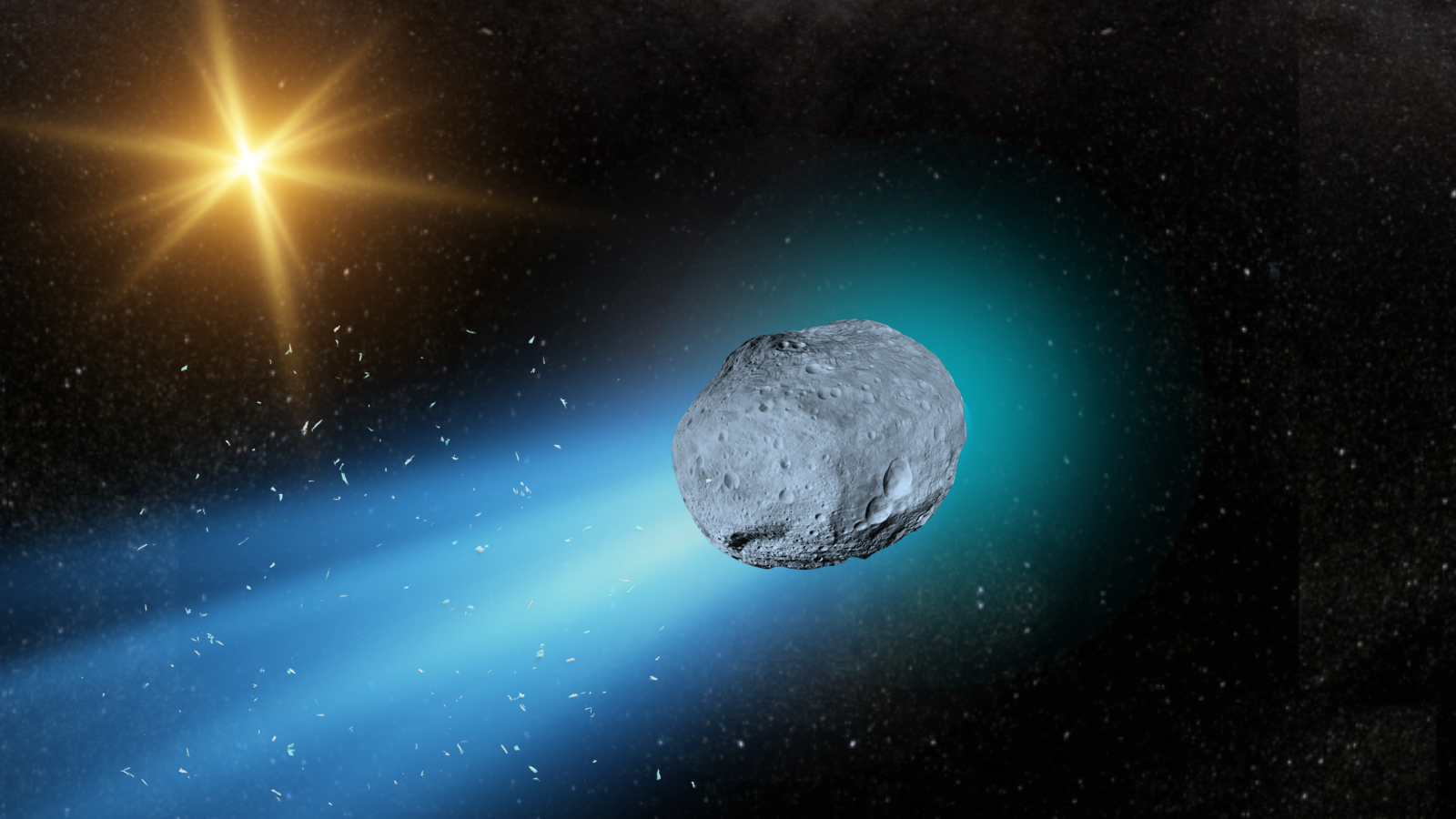

Astronomers worldwide are abuzz with the discovery of 3I/ATLAS, a new interstellar object that is currently shooting through our solar system on a one-way trajectory. This celestial newcomer marks only the third confirmed interstellar object (ISO) ever spotted by humanity, following 1I/’Oumuamua in 2017 and 2I/Borisov in 2019.
The object was first spotted in data collected between June 25 and June 29 by the Asteroid Terrestrial-impact Last Alert System (ATLAS), which utilizes telescopes in Hawaii, Chile, and South Africa. Initial observations were made on July 1, 2025, by the NASA-funded ATLAS survey telescope in Rio Hurtado, Chile. Within 24 hours of its initial sighting, NASA confirmed that the object’s extreme speed and trajectory indicated it did not originate from our solar system and is destined to leave again. Pre-discovery observations of 3I/ATLAS, initially dubbed A11pl3Z, have since been gathered from various archives, extending back to June 14.
An “Uninvited Guest” Turns Comet
Initially, researchers assumed 3I/ATLAS was an asteroid, but subsequent observations have revealed characteristics more akin to a comet. The International Astronomical Union’s Minor Planet Center noted “tentative signs of cometary activity,” including a surrounding bright cloud of gas and ice, known as a coma, and what appears to be a tail. Its proposed comet name is C/2025 N1 (ATLAS).
This interstellar visitor is barreling towards the Sun at an astonishing speed of more than 130,000 mph (210,000 km/h). Its high speed and extremely flat trajectory are key indicators of its interstellar origin. Interestingly, while previous interstellar objects ‘Oumuamua and Borisov approached the Sun head-on relative to the Milky Way’s trajectory, 3I/ATLAS is approaching side-on, or perpendicular to the Sun’s path, a peculiar characteristic noted by astronomer Wes Fraser.
A Giant Among Interstellar Objects
Researchers estimate the comet and its coma to be up to 15 miles (24 kilometers) across, making it significantly larger than its predecessors, ‘Oumuamua and Comet Borisov, both of which were less than a mile (1.6 km) wide. Aster Taylor, a co-author of the new study, noted that while it’s hard to measure its exact size, it appears considerably larger. It is also traveling faster and on a straighter trajectory than the other two confirmed ISOs.
A Safe Passage and Future Visibility
3I/ATLAS was discovered approximately 4.5 astronomical units (AU) from the Sun (about 416 million miles or 670 million km). It will make its closest approach to the Sun, or perihelion, on October 30, coming within 1.4 to 1.5 AU of our home star, just inside the orbit of Mars. Shortly before this, it will pass within 0.4 AU of Mars. The comet’s closest approach to Earth will occur in December, as it begins its journey back out of the solar system. NASA officials confirm that “the comet poses no threat to Earth and will remain at a [minimum] distance of at least 1.6 astronomical units (about 150 million miles or 240 million km).”
While currently too faint for casual stargazers, 3I/ATLAS is expected to brighten significantly as it nears the Sun and should become visible in the coming months. It should remain visible to ground-based telescopes through September, then reappear by early December after passing too close to the Sun for observation.
Origin and Unlikely Visitations
Researchers are keen to determine 3I/ATLAS’s origin. A study uploaded on July 7 suggests it likely came from the Milky Way’s “thick disk,” which accounts for about two-thirds of our galaxy’s stars, though a more precise location requires additional information. Wes Fraser noted it could have come from “any number of stars, not necessarily local ones”. Princeton University doctoral candidate Amir Siraj added that the comet could have been “wandering for a few billion years before paying us a chance visit”. Although newly discovered, the object likely entered Neptune’s orbit in mid-2023 and will pass the distant gas giant again in early 2028.
Unlike ‘Oumuamua, which some experts theorized could be a disguised spacecraft due to unusual acceleration, 3I/ATLAS appears to behave like a regular comet, making an extraterrestrial origin highly unlikely. While some, like astronomer Avi Loeb, are keen to search for “non-gravitational acceleration,” a visit to 3I/ATLAS by human probes is improbable due to a lack of prepared missions and current funding landscapes.
A Glimpse into Other Star Systems
The discovery of 3I/ATLAS was a significant group effort, underscoring the importance of international cooperation in astronomy. “We only have one shot at this object and then it’s gone forever,” said Darryl Seligman, an astronomer at Michigan State University and lead author of the first study on the object.
Experts anticipate that such discoveries will become more frequent. Marco Micheli of the European Space Agency’s Near Earth Object Coordination Centre believes we could see the next ISO “as quick as a year,” while Aster Taylor suggests “every two years”. This increased frequency is largely thanks to new observational capabilities from facilities like the Vera C. Rubin Observatory. Each new interstellar object offers an invaluable opportunity for researchers to learn about alien star systems and their exoplanets, providing “a little piece of low-hanging fruit from a tree that can tell us a great deal about the trees growing in some other neighbourhood,” according to Fraser.
©️ The Rocky Mountain Dispatch LLC. 2025
Leave a Reply