
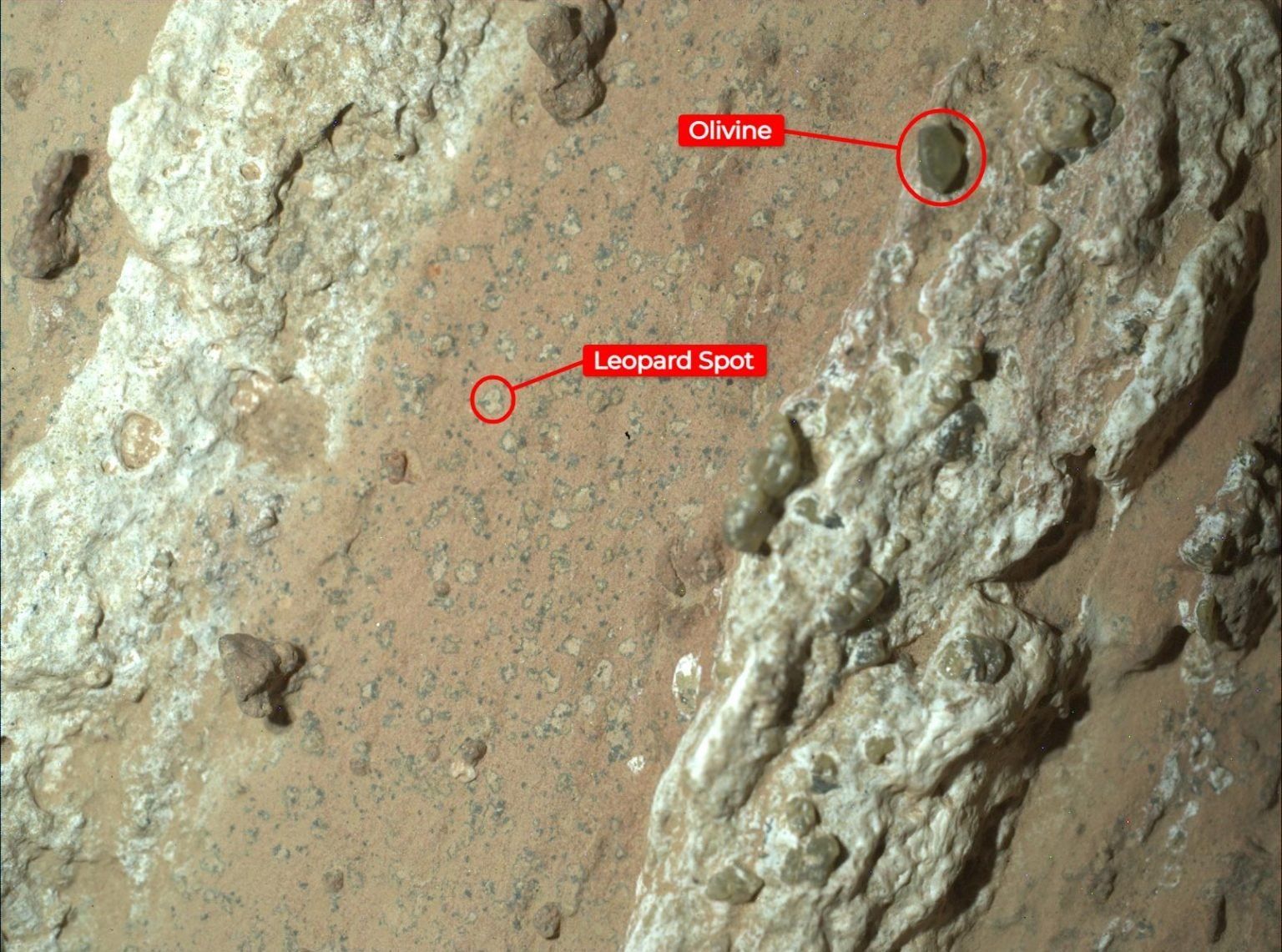

In a landmark discovery that could reshape our understanding of life in the universe, NASA’s Perseverance rover has identified what scientists are calling the most compelling evidence yet of ancient microbial life on Mars. The findings, announced September 10 and published in Nature, center on a rock sample collected from the Jezero Crater—an ancient lakebed long considered one of the most promising sites for astrobiological research.
The Rock That Could Rewrite History
The sample, nicknamed Cheyava Falls, was extracted from a fine-grained mudstone formation within the Bright Angel outcrop in the Neretva Vallis region of Jezero Crater. This area, shaped by water flow billions of years ago, has yielded sedimentary rocks rich in clay and silt—materials known on Earth to preserve organic matter.
NASA scientists report that the sample contains:
- Organic carbon compounds, essential building blocks of life
- Vivianite, an iron phosphate mineral often associated with decaying biological material on Earth
- Iron sulfide and ferrous iron nodules, indicative of low-temperature redox reactions that may involve organic matter
These features, especially the presence of vivianite and complex carbon structures, qualify as potential biosignatures—chemical or mineral traces that may have been formed by biological processes.
A Closer Look: The “Leopard Spots” of Mars
The most visually striking feature of Cheyava Falls is a pattern of millimeter-sized off-white splotches surrounded by darker material, dubbed “leopard spots” by the research team. These spots contain iron, phosphate, and sulfur—elements that, on Earth, are frequently linked to microbial metabolism.
NASA’s instruments PIXL (Planetary Instrument for X-ray Lithochemistry) and SHERLOC (Scanning Habitable Environments with Raman and Luminescence for Organics and Chemicals) confirmed the presence of these biosignature candidates. The textures and chemical gradients suggest post-depositional interactions between organic molecules and minerals, consistent with microbial activity—but not yet definitive proof.
Scientific Caution and the Path Forward
While the discovery is being hailed as a major milestone, NASA scientists emphasize that biosignatures are not the same as fossilized life. The evidence must be corroborated through further analysis, ideally in Earth-based laboratories. The sample, now designated “Sapphire Canyon,” is one of 27 cores collected by Perseverance and is slated for return via the Mars Sample Return mission in the early 2030s.
“This is the closest we’ve ever come to discovering life on Mars,” said NASA Acting Administrator Sean Duffy. “The identification of a potential biosignature on the Red Planet is a groundbreaking discovery, and one that will advance our understanding of Mars”.
Implications for Astrobiology
If confirmed, the presence of biosignatures in Martian rock would suggest that life is not unique to Earth—and that microbial ecosystems may have once thrived on our planetary neighbor. The discovery also strengthens the case for future crewed missions to Mars, where in-situ analysis could accelerate the search for life.
As Perseverance continues its journey across Jezero Crater, each sample it collects brings us closer to answering one of humanity’s most profound questions: Are we alone in the universe?
Leave a Reply