
Stargazers across the Northern Hemisphere are in for a rare celestial treat this October as two bright comets—C/2025 R2 (SWAN) and C/2025 A6 (Lemmon)—are expected to be visible to the naked eye. Their arrival coincides with the peak of the Orionid meteor shower and a new moon, creating ideal conditions for observation.
Comet SWAN R2, discovered on September 11 by Ukrainian amateur astronomer Vladimir Bezugly via NASA-ESA’s Solar and Heliospheric Observatory (SOHO), is a long-period comet with an estimated orbital cycle of 22,554 years. It will pass within 0.27 astronomical units (AU) of Earth—approximately 25 million miles—on October 21. Its tail, spanning a distance equivalent to five full moons, may brighten to magnitude 4, making it visible without telescopes in dark-sky locations.
Comet Lemmon, first identified earlier this year by the Mount Lemmon Survey in Arizona, will approach Earth at a distance of 0.60 AU. Though slightly farther than SWAN, it is also expected to reach magnitude 4, offering similar visibility. Lemmon will be observable in both morning and evening skies, while SWAN will appear near Mars after dusk.
The best viewing window for both comets is October 20–23, with October 21 being optimal due to the absence of moonlight. Observers in rural areas of Colorado and other northern regions will have the clearest views.
Adding to the spectacle is the Orionid meteor shower, which peaks October 22–23. Caused by debris from Halley’s Comet, the Orionids typically produce up to 20 meteors per hour. Scientists speculate that Earth may also pass through SWAN’s debris trail between October 4–6, potentially triggering a secondary meteor shower.
Astronomers are particularly excited about SWAN R2’s appearance, given its ancient origin and active tail formation. The simultaneous visibility of two bright comets under favorable conditions is exceedingly rare. The last naked-eye comet was C/2020 F3 (NEOWISE) in July 2020.
For optimal viewing, experts recommend using binoculars or small telescopes, though both comets may be seen unaided in dark locations. Urban observers are encouraged to travel to less light-polluted areas for the best experience.
This convergence of cosmic events—two comets, a meteor shower, and a new moon—marks one of the most significant skywatching opportunities of the decade.
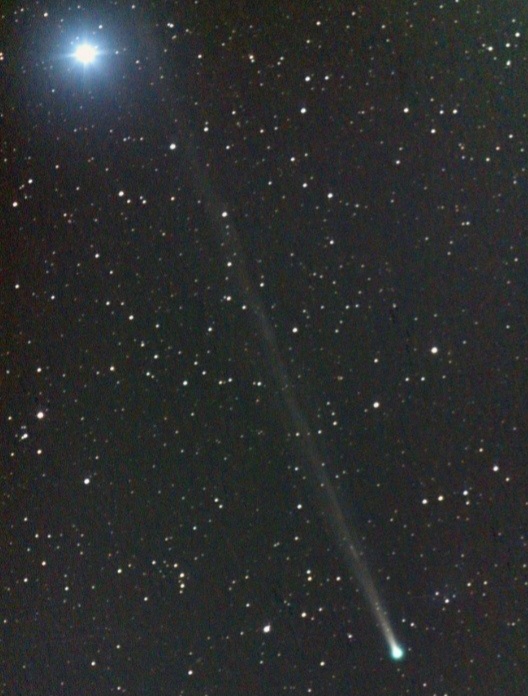
Twin Comets to Illuminate October Skies
Discover more from
Subscribe to get the latest posts sent to your email.
Leave a Reply