
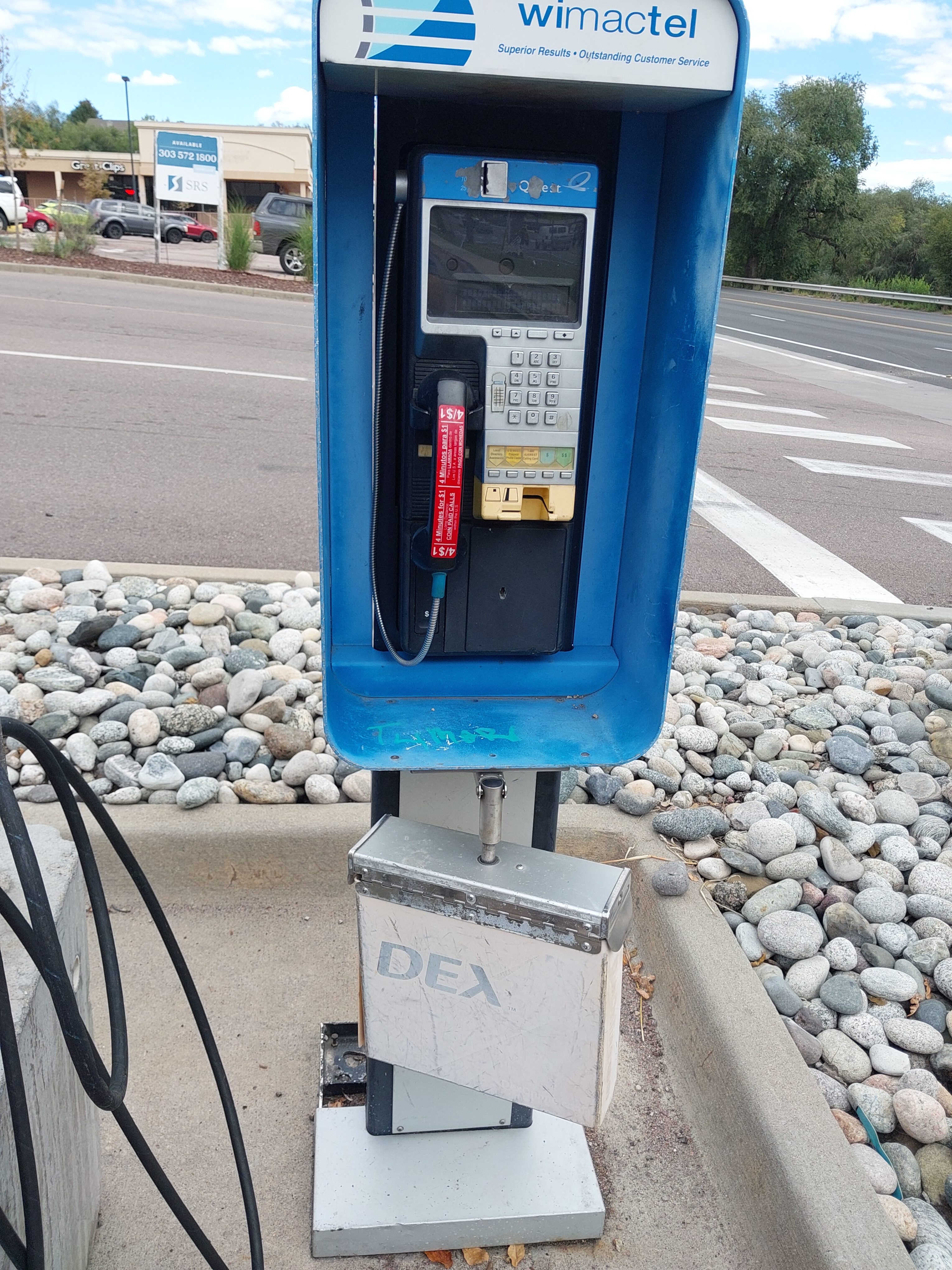
In a city that prides itself on progress, it’s rare to stumble upon a relic that feels like it’s been plucked straight from a different decade. But that’s exactly what happened when I found myself standing between a weathered air pump and the sign for a King Soopers gas station—staring at a fully intact public payphone.
Yes, a payphone. Red handset, coin slot, keypad, and all.
The blue enclosure, labeled “Wimactel,” looked like it hadn’t seen a quarter since the Bush administration. Yet there it stood, mounted on a concrete base surrounded by decorative rocks, as if waiting patiently for someone to dial home from 1997. Next to it, a metal box labeled “DEX” added a touch of mystery—perhaps a maintenance panel, or maybe something more clandestine. But for us, the time travelers from the last century, we know this “DEX” is the metal box that kept the phone book—before, well, the future came along. And the future was called Google.
The whole setup felt like a time capsule wedged into the everyday bustle of a grocery store and gas station parking lot.
It wasn’t just the phone itself that struck me—it was the placement. Nestled between the utilitarian hum of an air pump and the commercial glow of the King Soopers gas station sign, the payphone seemed almost poetic. A forgotten sentinel of analog communication, quietly resisting the tide of digital convenience. Oddly enough, this echo of the past sits in a strip mall that also houses a thrift store—a place to buy other artifacts from the past. And you can still use those. The payphone? Not so lucky.
For a moment, I didn’t feel like an editor chasing deadlines. I felt like a traveler who’d stumbled into a portal—one that led back to a time when calls cost coins, and the phrase “collect call” meant something. It reminded me that not all progress erases the past. Sometimes, it just builds around it.
So if you’re near that stretch of pavement and spot the blue box with the red receiver, take a moment. Pick it up. Listen. You might not hear a dial tone, but you’ll feel something else: the echo of a slower, simpler time. Close your eyes and envision yourself dialing—and listening to the call from the past. Maybe it’s me on the other end, calling from a newsroom lit by halogen lamps and cluttered with stacks of paper, asking if the deadline’s been met and whether the lead still holds. Maybe I’m calling to remind you that stories—like payphones—don’t disappear. They just wait to be rediscovered.
A Portal to the Past: Forgotten Payphone Resurfaces in Colorado Springs
Discover more from
Subscribe to get the latest posts sent to your email.
Leave a Reply