
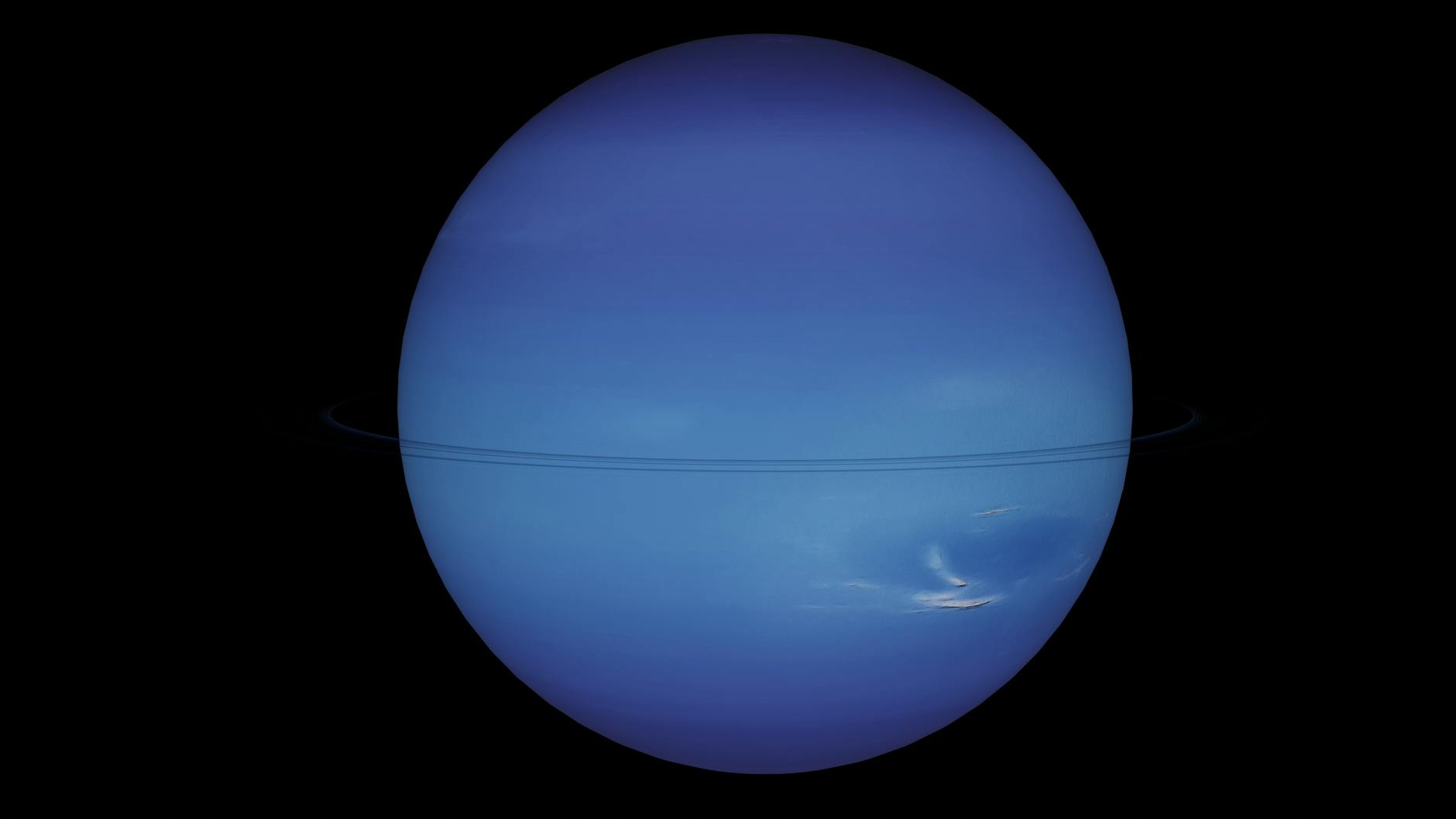
In a bold leap forward for planetary science, researchers Luca Morf and Ravit Helled of the University of Zürich have unveiled a new framework for modeling the interiors of Uranus and Neptune—one that upends the traditional view of these planets as simple “ice giants.” Published in Astronomy & Astrophysics, their study reveals that both worlds may be far more geologically and compositionally diverse than previously imagined.
A New Way to Peer Inside a Planet
Rather than relying on rigid assumptions or oversimplified profiles, Morf and Helled developed an iterative algorithm that begins with randomized density profiles and refines them until they satisfy three key conditions: hydrostatic equilibrium, agreement with observed gravitational moments, and thermodynamic and compositional consistency. This approach bridges the gap between empirical flexibility and physical rigor, allowing for a wide spectrum of plausible planetary interiors.
The result? A suite of self-consistent models that show Uranus and Neptune could be either water-rich or rock-dominated, convective or stable, and that their magnetic fields and thermal histories are deeply tied to these internal variations.
Uranus: Four Faces of a Giant
The study presents four distinct models for Uranus (U1–U4), each with dramatically different internal compositions and thermal structures:
- U1 and U3 depict Uranus as a classic ice giant, with water dominating the interior and rock-to-water mass ratios as low as 0.04 and 0.08. These models feature multiple convective zones and central temperatures ranging from 13,000 K to over 20,000 K.
- U2 and U4, by contrast, suggest a rock-heavy Uranus, with rock-to-water ratios of 3.92 and 0.64. These models are almost entirely convective and reach central temperatures around 6,000 K. Notably, hydrogen and helium are present even in the deep interior, with mass fractions up to 23%.
All models include ionic water layers—regions where water behaves like a conductive fluid—supporting the idea that Uranus’ magnetic field arises from deep convective zones. The outermost convection zones are especially rich in hydrogen and helium, with mass fractions between 62% and 73%.
Neptune: Ice, Rock, and Iron
Neptune’s interior proves equally complex. The four models (N1–N4) span from water-dominated to rock-rich configurations:
- N1 and N4 support the traditional ice giant view, with low rock-to-water ratios (0.20 and 0.26) and modest hydrogen-helium content. Yet even these models differ: N1 has a central density of 18.4 g/cm³ and stable inner layers, while N4 features a fully convective deep interior and a central density of just 6.2 g/cm³.
- N2 and N3 depict Neptune as a rock giant, with over half its mass in rocky material and rock-to-water ratios of 1.78 and 1.72. Central temperatures soar to 28,000 K in N2, which also contains significant iron (18% by mass). N3, meanwhile, includes hydrogen-helium in the core, consistent with formation models involving composition gradients.
Each Neptune model includes ionic water zones and convective layers, but the location and extent of these regions vary widely. Temperature jumps of over 500 K are observed between pressure layers, and density discontinuities suggest complex layering and mixing processes.
Magnetic Fields and Mixing Mysteries
One of the study’s most striking implications is its explanation for the planets’ unusual magnetic fields. Both Uranus and Neptune exhibit non-dipolar, off-axis magnetic fields that defy simple dynamo models. The presence of ionic water in convective zones offers a plausible mechanism for these fields, and the models suggest that Uranus’ dynamo region lies deeper than Neptune’s.
Moreover, all models remain above the demixing curves for hydrogen-helium-water mixtures, meaning no phase separation occurs—contrary to some earlier predictions. This consistency reinforces the plausibility of the inferred convection zones and magnetic field generation.
A Call for Better Data
Morf and Helled’s work underscores the limitations of current observational data. Despite decades of study, the gravitational moments of Uranus and Neptune remain imprecise, and the lack of direct measurements from orbiters leaves many questions unanswered. The authors argue that future missions—equipped with high-precision instruments and possibly seismology-inspired techniques—could help resolve the compositional degeneracy and refine our understanding of these enigmatic worlds.
Conclusion: Beyond the Ice Giant Label
This study challenges the simplistic classification of Uranus and Neptune as “ice giants.” Instead, it paints a picture of two planets with rich internal diversity, shaped by complex formation histories and dynamic processes. Whether icy or rocky, convective or stable, these worlds demand a more nuanced view—one that embraces uncertainty and explores possibility.
For readers of the Rocky Mountain Dispatch, this research offers a reminder that even the coldest corners of our solar system are alive with mystery. And as we look to the stars—and to the growing catalog of Neptune-sized exoplanets—we carry with us the tools to imagine, model, and eventually understand the hidden hearts of distant worlds.
Leave a Reply