
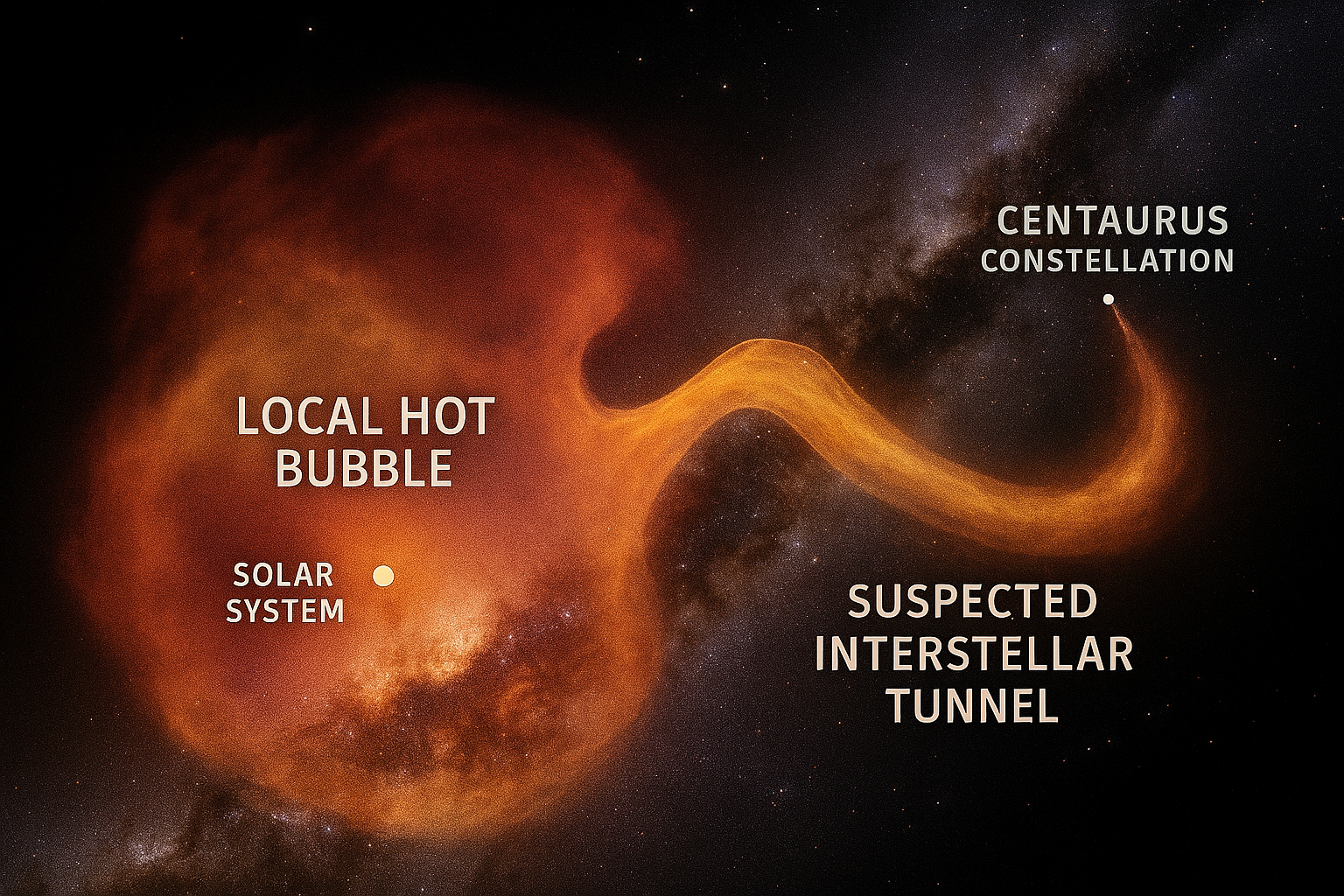
Astronomers have identified a vast channel of hot, low-density gas that appears to extend from our solar system toward distant stars in the Centaurus constellation. This newly mapped structure, described by some researchers as an “interstellar tunnel,” suggests that our solar system is part of a larger network of plasma pathways within the Milky Way.
The discovery emerged from recent observations using the eROSITA X-ray telescope, operated by the Max Planck Institute. Scientists were studying the Local Hot Bubble, a region of million-degree plasma that surrounds the solar system and spans more than 1,000 light-years. Their analysis revealed that this bubble is not a closed cavity, but rather connects to other regions of hot gas through filament-like structures.
These channels are not physical tunnels in the traditional sense. Instead, they are regions of space where magnetic fields and plasma density allow for the freer movement of energetic particles. The suspected tunnel toward Centaurus may serve as a conduit for cosmic rays and interstellar winds, influencing how radiation and charged particles travel across the galaxy.
The existence of such a structure supports theories that our local galactic environment was shaped by multiple supernovae. These ancient explosions likely carved out cavities in the interstellar medium, leaving behind a network of hot, low-density regions. The Local Hot Bubble is one of these remnants, and the newly identified tunnel may be a direct result of that violent history.
Understanding these plasma channels has practical implications. They may affect the shape and behavior of the heliosphere, which is the magnetic shield that protects Earth from cosmic radiation. They also offer insight into the broader architecture of the Milky Way, helping astronomers trace how stars and stellar remnants interact across vast distances.
For readers in Colorado’s mountain communities, this discovery offers a moment of cosmic reflection. Just as trails connect valleys and ridgelines across the Rockies, these interstellar pathways may link stellar neighborhoods across the galaxy. The solar system is not a solitary outpost, but part of a dynamic and interconnected galactic landscape.
The Rocky Mountain Dispatch will continue to follow developments in space science, bringing clarity and context to discoveries that shape our understanding of the universe.
A Tunnel Through the Stars? Astronomers Trace a Cosmic Channel from Our Solar System
Discover more from
Subscribe to get the latest posts sent to your email.
Leave a Reply