
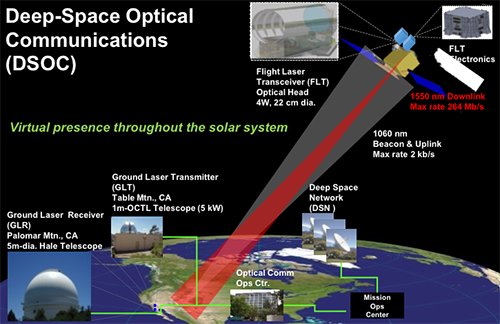

NASA is set to launch a technology demonstration that will test the use of lasers to transmit data from deep space to Earth. The Deep Space Optical Communications (DSOC) project will use a laser transceiver to send and receive data with two ground stations in Southern California. The goal of the project is to demonstrate the feasibility of using laser communications for future deep space missions, such as sending astronauts to Mars.
Laser communications offers several advantages over traditional radio frequency communications. Lasers can transmit data at much higher speeds, which means that more data can be sent in a shorter amount of time. This is important for deep space missions, which generate large amounts of data from scientific instruments and cameras. Lasers are also more efficient than radio waves, which means that they can transmit data over longer distances with less power. This is important for missions that travel far from Earth, where the amount of solar power available is limited.
The DSOC project will use a number of new technologies to demonstrate the feasibility of laser communications for deep space missions. The laser transceiver will be equipped with a photon-counting camera that can detect individual photons of light. This camera is much more sensitive than traditional detectors, which means that it can detect faint signals from distant spacecraft. The transceiver will also be equipped with a new pointing system that can accurately track the ground stations even as the spacecraft moves through space.
The DSOC project is scheduled to launch in October 2023 on the Psyche mission. The Psyche mission will travel to a metal-rich asteroid of the same name. During the first two years of the mission, the DSOC transceiver will communicate with the ground stations in Southern California. The project will demonstrate the feasibility of using laser communications for deep space missions and help to pave the way for future missions, such as sending astronauts to Mars.
Here are some additional details about the DSOC project:
- The laser transceiver will be mounted on the Psyche spacecraft.
- The transceiver will communicate with two ground stations in Southern California: the Optical Communication Telescope Laboratory at JPL’s Table Mountain Facility and the Hale Telescope at Caltech’s Palomar Observatory.
- The project will demonstrate the feasibility of transmitting data at speeds of up to 100 times faster than current radio frequency communications systems.
- The project will help to develop new technologies for laser communications, such as more sensitive detectors and more accurate pointing systems.
- The DSOC project is the latest in a series of optical communication demonstrations funded by NASA.
The DSOC project is a significant step forward in the development of laser communications for deep space missions. The project has the potential to revolutionize the way that data is transmitted from space, and it could help to make future missions, such as sending astronauts to Mars, a reality.
©️ Rocky Mountain Dispatch 2023
Leave a Reply