
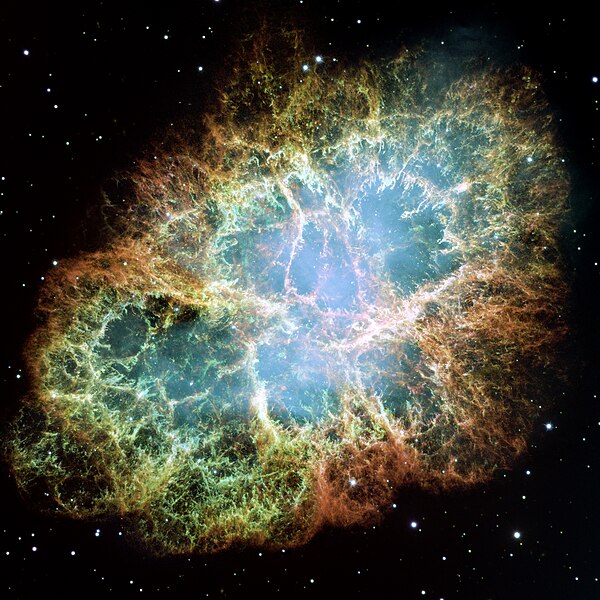

A new study published in the journal Nature Astronomy has found that two supernovae explosions occurred close enough to Earth to have a significant impact on life on the planet, approximately 3 million and 7 million years ago.
Supernovae are the cataclysmic explosions that mark the end of the life cycle of massive stars. They are incredibly powerful events, releasing more energy in a few seconds than our Sun will produce in its entire lifetime.
The study’s authors, led by Henrik Svensmark of the Technical University of Denmark, analyzed the presence of radioactive isotopes in sediments from the ocean floor. These isotopes are created by the interaction of cosmic rays with Earth’s atmosphere. Cosmic rays are high-energy particles that come from all over the universe, and their intensity is affected by supernovae explosions.
The researchers found that there were two spikes in the levels of radioactive isotopes in the sediments, corresponding to supernovae explosions that occurred 3 million and 7 million years ago. These explosions would have released a massive amount of cosmic rays into the solar system, which would have had a significant impact on Earth’s environment.
One of the main effects of supernovae explosions is to increase the amount of cloud cover on Earth. This is because cosmic rays create charged particles in the atmosphere, which can act as nuclei for water droplets to form around. More clouds mean less sunlight reaching the surface of the Earth, which can lead to cooling.
The researchers found that the two supernovae explosions would have caused a global cooling of a few degrees Celsius. This cooling would have had a significant impact on life on Earth, as it would have changed the distribution of plant and animal species.
In addition to the cooling effect, supernovae explosions can also release a large amount of heavy elements into space. These elements are essential for life, but they can also be harmful in high concentrations. The researchers believe that the two supernovae explosions may have caused an increase in the levels of heavy metals in Earth’s oceans, which may have contributed to mass extinctions at the time.
The study’s findings suggest that supernovae explosions may play a more important role in the evolution of life on Earth than previously thought. The researchers say that future studies should focus on understanding the long-term effects of supernovae explosions on Earth’s environment and climate.
Implications for the Future
The findings of this study have a number of implications for our understanding of the universe and our place in it. First, they show that supernovae explosions can have a significant impact on life on Earth, even from relatively distant distances. Second, they suggest that the evolution of life on Earth may be linked to cosmic events that occur outside of our solar system.
The study also raises the possibility that a future supernova explosion could have a negative impact on life on Earth. However, it is important to note that the frequency of supernovae explosions is very low, and the chances of one occurring close enough to Earth to cause significant damage are very small.
Overall, the study provides new insights into the relationship between supernovae explosions and life on Earth. It is a reminder that we are all connected to the cosmos, and that even the most distant events can have a profound impact on our planet.
©️ Rocky Mountain Dispatch 2023
Leave a Reply