
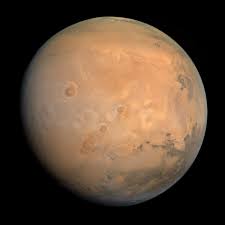

In a groundbreaking discovery, scientists have identified two distinct electrical current systems within the Martian ionosphere, the charged layer of Mars’s upper atmosphere. This finding, published in the journal Nature Communications, sheds light on the complex interplay between the solar wind, a stream of charged particles from the Sun, and Mars’s atmosphere.
The research, led by Jiawei Gao of the Chinese Academy of Sciences, utilized eight years of comprehensive data from NASA’s Mars Atmosphere and Volatile EvolutioN (MAVEN) mission. Unlike Earth, Mars lacks a global magnetic field to shield it from the solar wind. This interaction creates an induced magnetosphere around Mars, a dynamic region where magnetic fields and electrical currents control the movement of charged particles.
The study identified two main current systems in Mars’s ionosphere. The first system, termed JIn, aligns with the solar wind electric field but shows an unexpected asymmetry. The second system, named JSq, corresponds to the flow patterns of Martian neutral winds, similar to Earth’s Sq current system.
The researchers suggest that these current systems are generated by the interaction of the solar wind with Mars’s ionosphere and the dynamics of the planet’s neutral winds. These findings highlight the complex and intriguing nature of current systems on unmagnetized planets.
This discovery has broader implications for understanding the evolution of planetary atmospheres and the potential for life beyond Earth. The interaction between the solar wind and a planet’s atmosphere plays a crucial role in atmospheric escape, a process where atmospheric gases are lost to space. This process has significantly influenced the evolution of Mars’s climate and habitability over billions of years.
The research also suggests that similar current systems could exist in the ionospheres of other unmagnetized planets, such as Venus and Titan. This opens up exciting possibilities for future research and exploration
This discovery marks a significant advancement in our understanding of Mars and its unique space environment. It also opens up new avenues for research and exploration, as we continue to unravel the mysteries of the Red Planet and its place in the solar system.
©️ The Rocky Mountain Dispatch LLC. 2024
Leave a Reply