
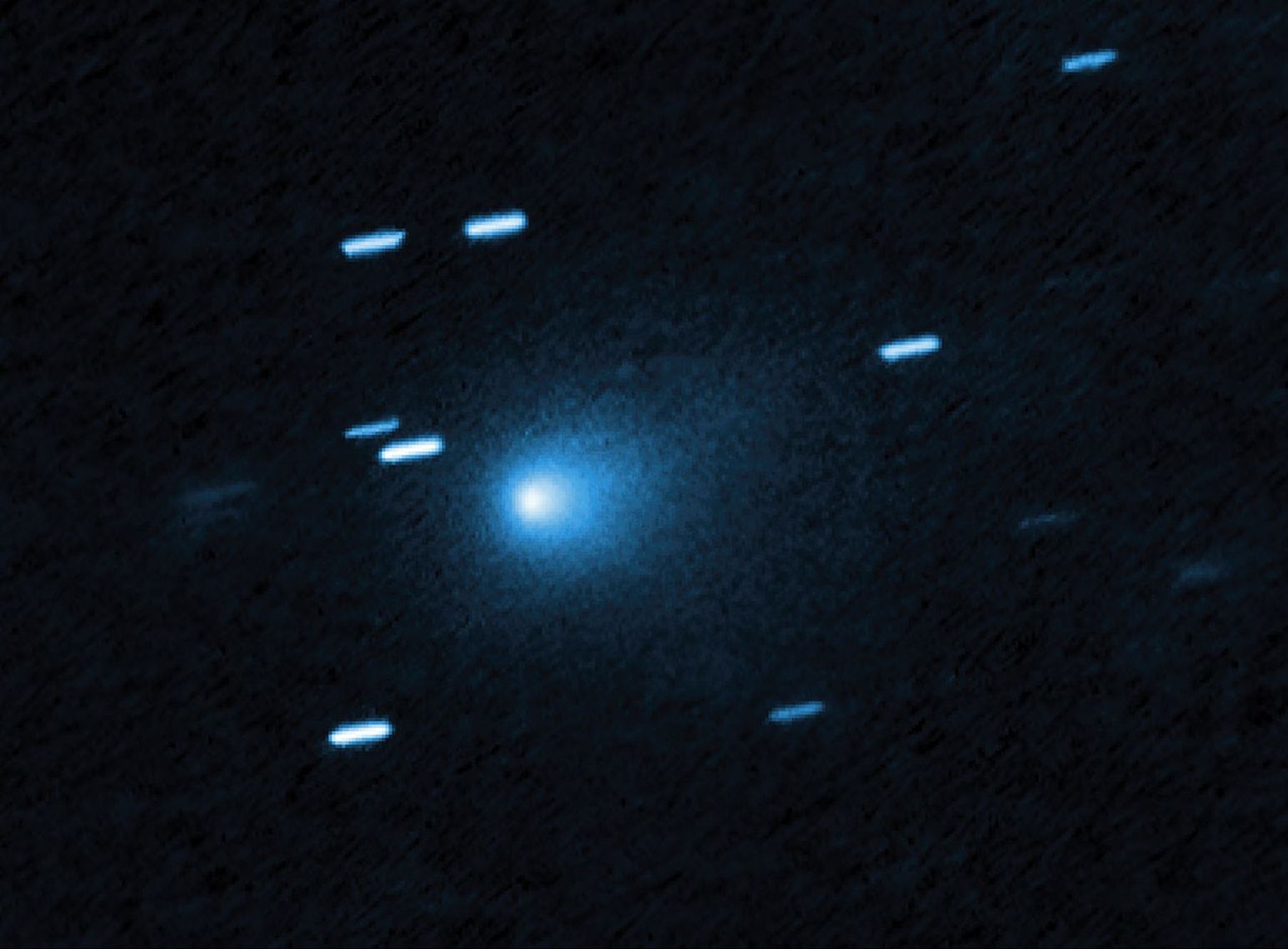
In the spring of 2024, astronomers confirmed the arrival of a rare visitor: 3I/ATLAS, the third known interstellar object to pass through our solar system. Following in the wake of 1I/ʻOumuamua and 2I/Borisov, this icy traveler offered scientists a fleeting but profound glimpse into the chemistry and chaos of planetary systems beyond our own.
This publication first reported on 3I/ATLAS shortly after its trajectory was confirmed, noting its unusually high velocity and hyperbolic orbit. That velocity—estimated at roughly 130,000 miles per hour—sparked curiosity and speculation, including one question that continues to echo: did it travel faster than the speed of light?
The answer is unequivocally no.
The speed of light in a vacuum is approximately 670,616,629 miles per hour. By comparison, 3I/ATLAS was moving at less than 0.02% of that speed. While its pace is staggering by human standards—faster than any spacecraft we’ve built—it remains well within the bounds of known physics. No natural object has ever been observed traveling faster than light, and doing so would violate Einstein’s theory of relativity.
But speed alone wasn’t what made ATLAS remarkable. It was what the object carried with it.
Using the James Webb Space Telescope’s Near Infrared Spectrograph (NIRSpec), researchers detected complex organic molecules in the comet’s coma—carbon-based compounds not commonly found in solar system comets. These findings suggest that 3I/ATLAS formed in a chemically rich environment, possibly around a young star with conditions unlike those of our own Sun.
Further observations from the Hubble Space Telescope revealed signs of fragmentation and irregular outgassing, hinting at a violent past. Some scientists speculate that 3I/ATLAS may have been part of a larger body torn apart by gravitational forces before being ejected into interstellar space. Its fractured structure and erratic behavior support this theory, painting a picture of a comet shaped by cosmic trauma.
Ground-based telescopes, including Gemini North in Hawaii, helped refine the object’s trajectory and physical characteristics. These data confirmed its interstellar status and allowed astronomers to study its nucleus and rotation in unprecedented detail.
The arrival of 3I/ATLAS was more than a scientific curiosity—it was a rare opportunity to compare the building blocks of distant planetary systems with our own. Its chemical fingerprint, structural anomalies, and interstellar journey challenge long-held assumptions about comet formation and the diversity of planetary environments across the galaxy.
As 3I/ATLAS fades into the void, it leaves behind a trail of data and wonder. In a universe filled with stars and silence, it spoke volumes in its brief visit—reminding us that the cosmos is not only vast, but varied.
Leave a Reply