
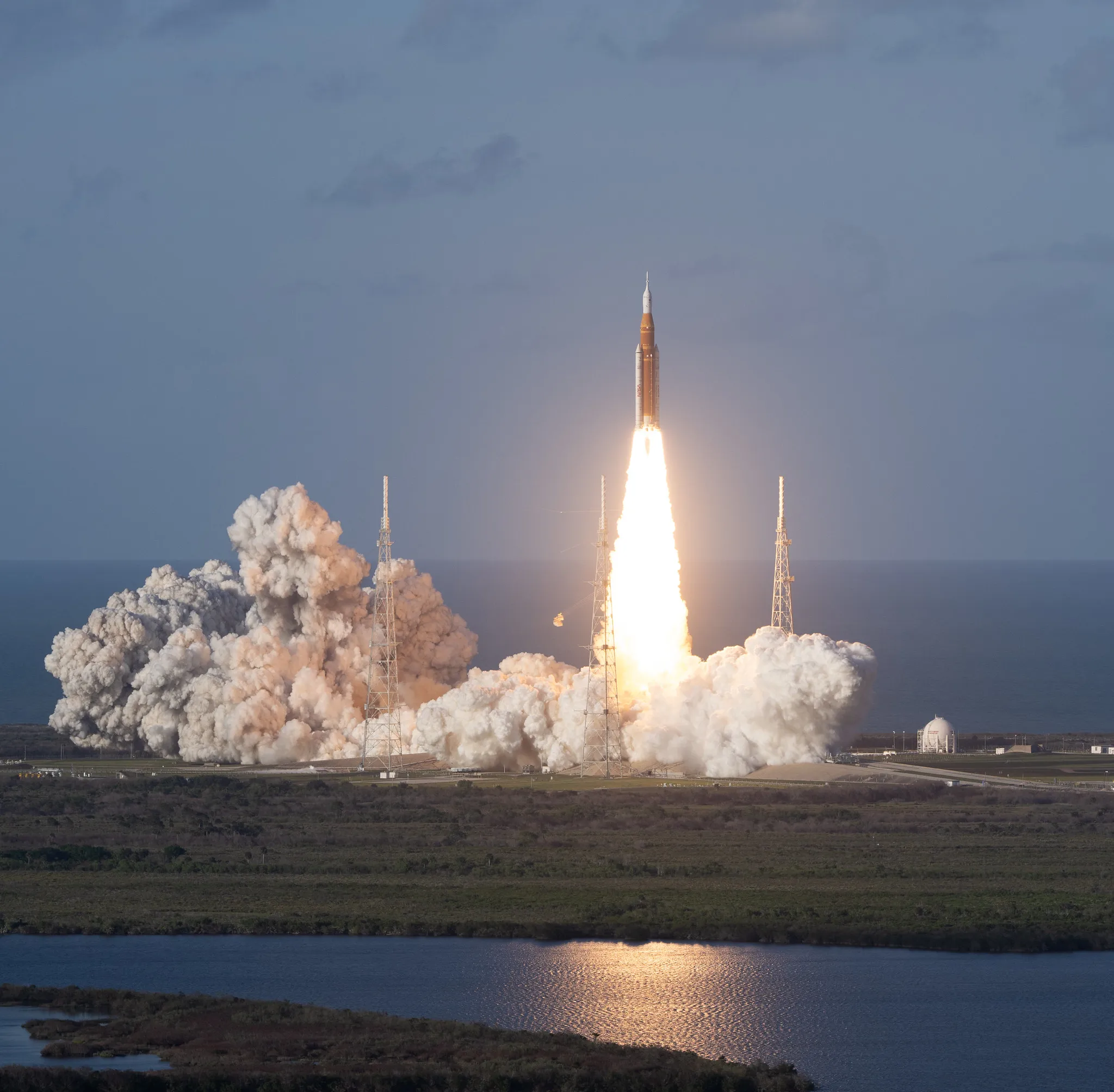
NASA’s Artemis II mission roared off the pad this evening in Florida, marking the first crewed journey toward the Moon in more than half a century — and Colorado played an outsized role in making it possible. From the Orion spacecraft’s engineering to the solid rocket boosters that lifted the crew skyward, the state’s aerospace workforce was woven into nearly every stage of the launch.
The Space Launch System lifted off shortly after sunset, sending Commander Reid Wiseman, Pilot Victor Glover, Mission Specialist Christina Koch, and Canadian astronaut Jeremy Hansen on a ten‑day flight that will carry them around the Moon and back. It is the first time humans have traveled beyond low Earth orbit since Apollo 17 in 1972, and the mission is widely viewed as the gateway to a sustained American return to the lunar surface.
For Colorado, the launch was more than a national milestone. It was a moment of local pride for the more than 14,000 residents whose work contributed directly to the Artemis program. Lockheed Martin’s Waterton Canyon campus in Littleton remains the heart of Orion spacecraft development, and engineers there were on console throughout the launch, monitoring telemetry and system performance as the crew climbed into orbit. Northrop Grumman teams with Colorado ties contributed to the massive twin boosters that provided most of the thrust needed to lift Artemis II off the ground, while dozens of smaller firms across the state supplied avionics, communications architecture, and mission‑critical safety systems.
Colorado’s aerospace sector is now the second‑largest in the nation, and its influence on Artemis II reflects decades of investment in deep‑space engineering and human‑rated systems. State leaders and industry officials have long argued that Colorado’s combination of technical expertise, military presence, and research institutions makes it uniquely positioned to support NASA’s long‑term lunar strategy. Tonight’s launch offered a vivid demonstration of that claim.
As the Orion spacecraft settled into orbit and deployed its solar arrays, engineers in Colorado watched the data stream in real time. Many have spent years preparing for this moment, and several described the launch as both historic and deeply personal. They grew up watching Apollo footage; now they are helping write the next chapter.
Artemis II will carry its crew farther from Earth than any human mission in history, looping behind the far side of the Moon before returning home. The flight is designed to validate life‑support systems, navigation capabilities, and deep‑space communications ahead of future missions that will attempt the first lunar landing of the Artemis era.
For Colorado’s aerospace community, the work is far from over. Companies across the state are already contributing to future lunar landers, habitat concepts, and communications networks intended to support a sustained human presence on and around the Moon. But tonight, as watch parties unfolded from Colorado Springs to Denver, the focus was on the moment: a crewed spacecraft rising into the sky on the strength of hardware, software, and expertise built in the Centennial State.
Leave a Reply