
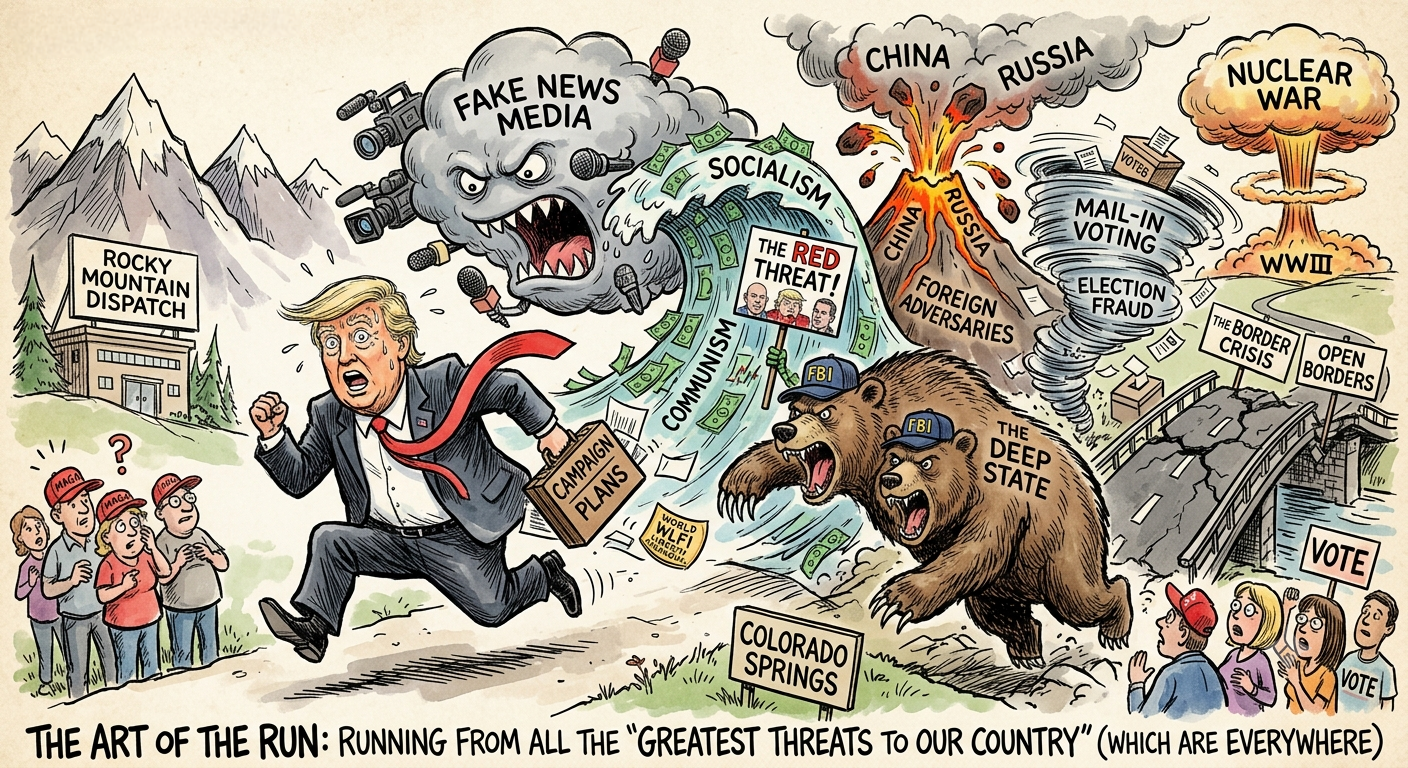
In modern American political discourse, nuance has officially been declared dead, buried, and replaced with a rotating wheel of existential crises.
If you have paid attention to Donald Trump’s speeches over the past decade, you may have noticed a recurring rhetorical theme: nearly everything is, at one point or another, the single most dangerous thing to our country. Depending on the day, the headline, or the rally location, that supreme title has been awarded to the mainstream news media, mail-in voting ballots, political prosecutors, the southern border, electric vehicle mandates, nuclear weapons, and radical socialism. While language experts estimate Trump has deployed this extreme superlative hundreds of times throughout his political career, his frequent habit of labeling mainstream political opponents as communists raises an obvious question: does anyone actually know what that word means anymore?
A Civics Refresher: Communism vs. Socialism
Before analyzing why politicians throw these labels around, it helps to review the actual political science definitions that often get lost in campaign soundbites.
In political theory, socialism serves as an intermediate economic framework where major public utilities, healthcare, and national infrastructure are state-regulated or publicly owned, yet private property and small business enterprise still exist. Under socialism, individual compensation is tied directly to a person’s contribution and output. This model is commonly seen in Western European nations and the Scandinavian Nordic Model, which operate as market-based capitalist economies equipped with heavy-duty social safety nets.
Communism, by contrast, represents a fundamentally different and more radical endpoint. In classic Marxist theory, communism is a completely stateless and classless society where all private property is abolished entirely. All means of production, land, and resources are held collectively by the public, with goods and services distributed strictly according to individual need rather than personal effort.
The Strategy Behind the “Red” Label
Calling political rivals communists or Marxists is not an accidental slip of the tongue; it is a calculated campaign strategy designed to achieve specific political objectives.
First, the label maximizes the political stakes. By framing opponents as communists rather than simply political rivals with differing views on taxation, the argument shifts from a routine policy debate to an apocalyptic battle for the nation’s survival. Second, it relies on guilt by association. When progressive or socialist-backed primary candidates win Democratic primaries, conservative strategists can easily brand the entire party hierarchy with a single, alarming term. Third, it taps into Cold War nostalgia. Drawing on classic Red Scare tactics—a rhetorical lineage tracing directly back to Trump’s early mentor, Roy Cohn—the label activates deep-seated historical anxiety regarding state control.
Political historians consistently point out that no mainstream American political party advocates for abolishing private property or creating a single-party state. However, in a 24-hour news cycle, describing your opponent as a center-left advocate for market regulation simply does not move the needle like declaring them a Marxist.
The Flip Side: The Ledger of Controversies
While Trump routinely paints his opponents as an existential threat to the republic, his critics point to an unprecedented ledger of personal, legal, and financial controversies surrounding him and his family.
On the legal front, a New York court found Trump and his adult sons liable for civil fraud involving inflated property values, resulting in a judgment exceeding $355 million. The parent company of his real estate business was convicted on 17 criminal tax fraud counts, while Trump himself previously agreed to a $25 million settlement over Trump University and faced the court-ordered dissolution of the Trump Foundation over misuse of charitable funds. Additionally, he was convicted in New York on 34 felony counts related to falsifying business records.
Ethical scrutiny has also focused heavily on his family’s blurred lines between public office and private business. Appointing Jared Kushner and Ivanka Trump as senior presidential advisors drew continuous criticism, particularly when Kushner’s private equity firm secured a $2 billion investment from Saudi Arabia’s sovereign wealth fund after leaving government, and when Ivanka secured fast-tracked Chinese trademarks while serving in the White House.
Financial disclosures reveal that Trump’s business empire generated over $1.6 billion in gross outside revenue during his first presidential term, even as he donated his official presidential salary. Following his return to public office, his earnings escalated further, with financial filings disclosing over $2.2 billion in single-year revenues heavily driven by roughly $1.4 billion from family-backed cryptocurrency ventures, including World Liberty Financial and digital token sales.
Deciding Who Holds the “Greatest Threat” Title
Ultimately, whether Donald Trump is the greatest threat to our country or its indispensable savior depends entirely on which side of the political aisle you occupy.
To his critics, he represents a direct threat to democratic norms, judicial independence, international alliances, and civic unity. To his supporters, he is a vital disruptor dismantling an entrenched political elite, securing national borders, cutting through federal bureaucracy, and protecting economic sovereignty. Meanwhile, many political scientists argue that the real greatest threats are rarely a single individual, but rather systemic problems like ballooning national debt, severe political polarization, foreign cyber-warfare, and institutional gridlock that prevents the country from solving basic challenges.
In the end, if every political opponent, policy mandate, and news outlet in America is simultaneously declared the single most dangerous threat ever faced, perhaps the truly dangerous thing is that we have completely run out of adjectives.
Leave a Reply