
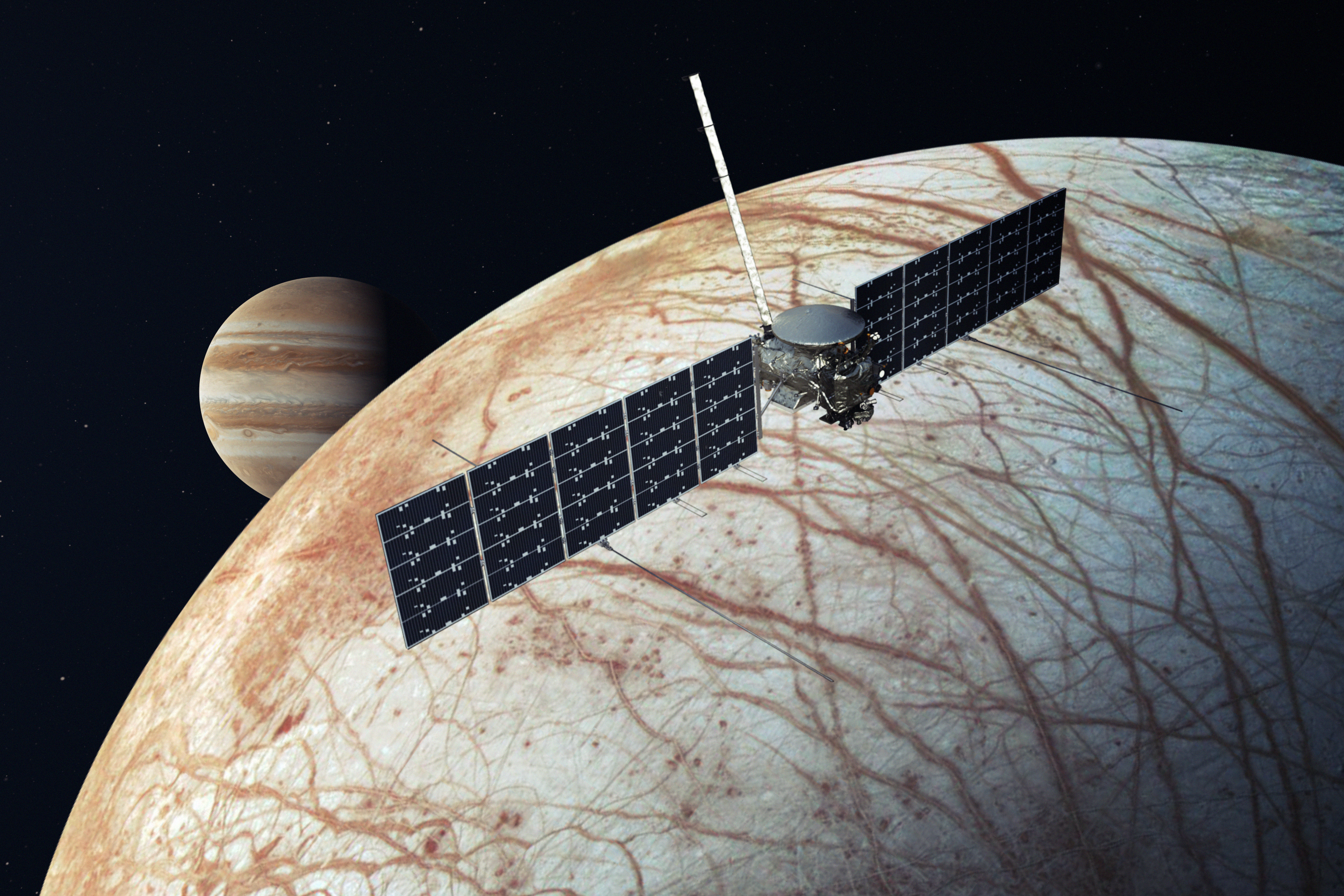

Excitement is reaching fever pitch at NASA’s Jet Propulsion Laboratory (JPL) as its Europa Clipper spacecraft undergoes final testing in preparation for its groundbreaking mission to Jupiter’s enigmatic ice-covered moon, Europa. Slated for launch in 2024, the Clipper promises to unlock secrets about this tantalizing celestial body and its potential to support life.
Europa: A Prime Target in the Search for Extraterrestrial Life
Scientists have long suspected that beneath Europa’s fractured, ice-encrusted surface lies a vast, global ocean of liquid water. This subsurface ocean, warmed by the tidal forces exerted by Jupiter’s immense gravity, has sparked intense speculation that Europa could harbor the ingredients essential for life.
“Europa Clipper is the culmination of decades of research and development,” says Dr. Robert Pappalardo, Europa Clipper project scientist at JPL. “This mission is poised to revolutionize our understanding of ocean worlds and their potential to host conditions favorable for life beyond Earth.”
Advanced Instrumentation to Probe Europa’s Secrets
Europa Clipper will not land on Europa but instead conduct a series of close flybys over multiple years. The spacecraft is equipped with a suite of highly sophisticated scientific instruments, each designed to shed light on a different aspect of the moon’s composition and internal structure.
Key instruments include:
- EIS (Europa Imaging System): A powerful camera system to map Europa’s surface in stunning detail, revealing geological features and potential signs of water plumes.
- REASON (Radar for Europa Assessment and Sounding: Ocean to Near-surface): A ground-penetrating radar to probe the thickness and structure of Europa’s ice shell, searching for hidden water pockets or even the vast subsurface ocean itself.
- MISE (Mapping Imaging Spectrometer for Europa): Measures infrared wavelengths to analyze surface composition, identifying compounds like salts and organic molecules that could hold clues to Europa’s habitability.
Launch Scheduled for 2024
The Europa Clipper is scheduled for launch aboard a SpaceX Falcon Heavy rocket from the Kennedy Space Center in Florida in October of 2024. Given the immense distances involved, the spacecraft is not expected to arrive in orbit around Jupiter until 2030.
“We have a long journey ahead,” notes Dr. Pappalardo. “But the potential scientific payoff of Europa Clipper is enormous. This mission could rewrite our textbooks about ocean worlds in our solar system and the broader search for life in the universe.”
©️ The Rocky Mountain Dispatch LLC. 2024

Leave a Reply