
Many of you might remember a column from about a month ago where Willow and I watched a yellowjacket make quick work of a daddy longlegs at the local park. That was an interesting follow-up to our 2023 encounter with a yellowjacket stealing a bite of ice cream, giving us a front-row seat to the local ecosystem at work. It seems the wasps of El Paso County are not quite done with our family just yet, but this week, it was Quinn’s turn for a wildlife discovery.
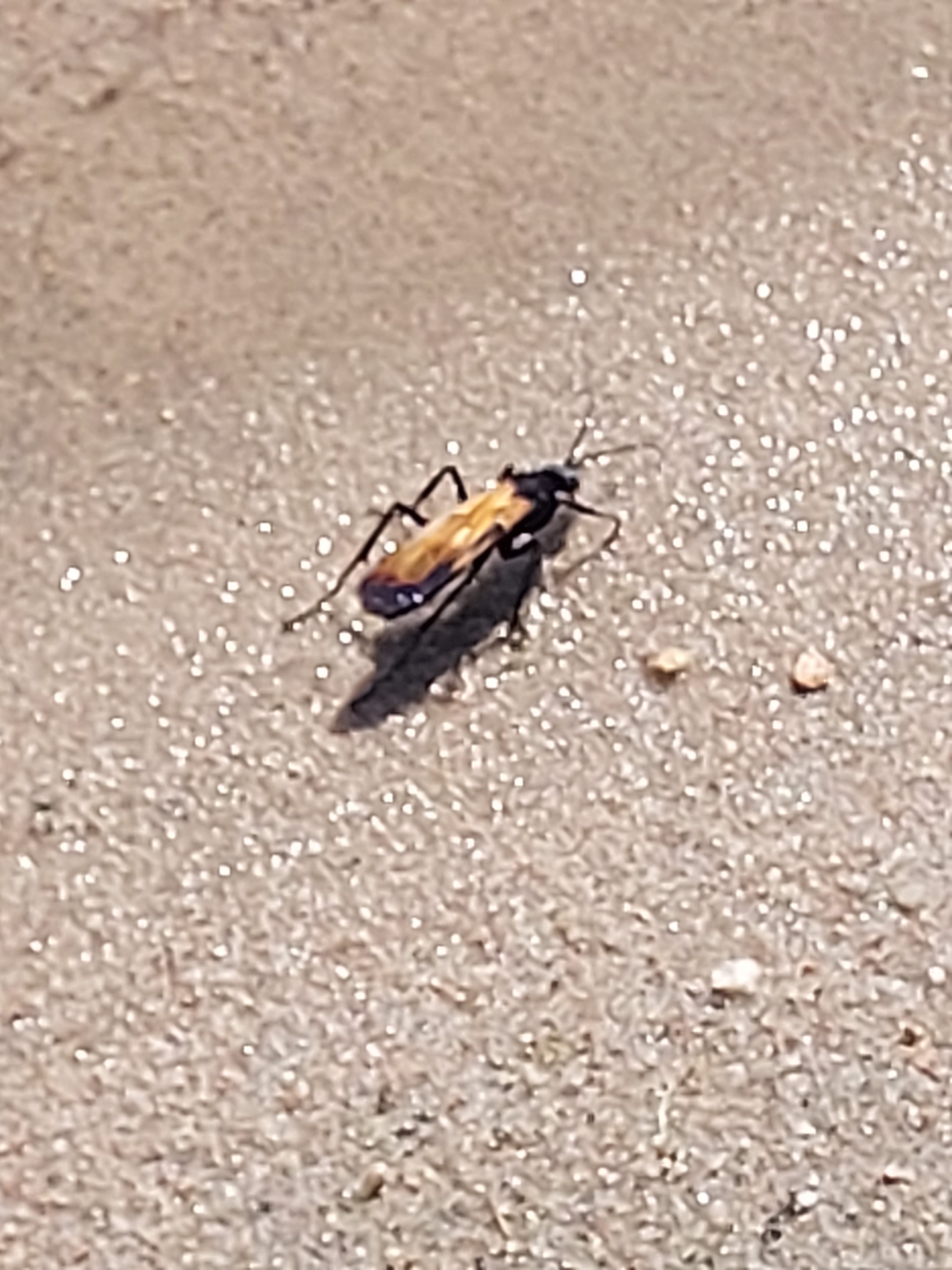
Quinn and I were taking in the sights down at Prospect Lake the other day when she spotted a large, dark insect resting on the sand. With the insect’s bright orange wings folded flat against its back, her first guess was that we had stumbled across a butterfly. It was a perfectly reasonable guess from a distance, but as we got a closer look, we realized this particular visitor was actually something a bit more intimidating: a Tarantula Hawk wasp.
A Warning in Orange and Blue
Tarantula Hawks are a type of spider wasp, and here in Colorado, there are six known species. They are large-bodied wasps that can grow up to two inches in length. Up close, their appearance is unmistakable—they typically feature metallic, iridescent blue-black bodies accented by vibrant orange or rust-colored wings.
While a butterfly uses bright colors to attract mates or blend into flowers, the Tarantula Hawk uses its striking color pattern as a warning. This visual signal is known as “aposematic coloration,” communicating to potential predators that the wasp possesses toxic venom and should be left alone.
The Nectar Gatherer and the Spider Hunter
So, what was a Tarantula Hawk doing hanging out with us down by the lake? Despite their fearsome name, adult Tarantula Hawks are actually nectarivorous. Both males and females feed almost exclusively on pollen and nectar from flowers, such as milkweed, and play a critical role as local pollinators. During the peak heat of the summer, it is incredibly common to find them landing on sandy shorelines to seek out a little moisture before they get back to foraging.
However, they earn the “hawk” moniker through their unique reproductive strategy. While the adults drink nectar, the female wasp hunts tarantulas to serve as a food source for her offspring. After locating a tarantula, the female delivers a powerful sting to permanently paralyze, but not kill, her prey. She then drags the immobilized spider into a burrow and lays a single egg on its abdomen. When the egg hatches, the larva feeds on the living tarantula from the inside out.
Look, But Don’t Touch
For all their intense hunting tactics, Tarantula Hawks are generally non-aggressive toward humans and are considered quite docile. They will typically only sting if they are directly threatened, provoked, or handled.
However, if you do cross their boundaries, there is a severe price to pay. The sting of a female Tarantula Hawk is rated as one of the most painful of any insect in the world. The late entomologist Justin Schmidt famously rated it at the very top of his sting pain index, describing the sensation as “blinding, fierce, and shockingly electric.” The intense pain usually subsides after a few minutes and causes no lasting damage to humans; it serves purely as a defense mechanism to give the wasp time to escape.
Whether it is watching yellowjackets on the hunt or spotting a butterfly in disguise at Prospect Lake, keeping an eye out for these incredible insects is a brilliant way to experience our local biodiversity. It is also a great reminder that some of nature’s most fascinating creatures are best admired from a safe distance
Wildlife Sunday: A Butterfly in Disguise? Spotting the Tarantula Hawk at Prospect Lake
Discover more from NEWS THAT MOVES YOU
Subscribe to get the latest posts sent to your email.
Leave a Reply