
COLORADO SPRINGS, Colo. — An international team of geochemists and paleontologists has discovered chemically confirmed traces of ancient blood preserved inside 115-million-year-old dinosaur bones, overturning long-standing scientific assumptions about how long fragile biological molecules can survive in the fossil record, according to a Curtin University release on ScienceDaily. The landmark study, published in the Proceedings of the National Academy of Sciences, identified intact heme signatures—key molecular components of oxygen-carrying hemoglobin—alongside collagen amino acids inside mineralized red blood cells within the limb bones of Aratasaurus museunacionali, a carnivorous theropod dinosaur unearthed in northeastern Brazil.
While earlier paleontological studies had spotted microscopic structures resembling blood cells inside ancient fossils, researchers had never conclusively verified the chemical survival of hemoglobin-derived molecules across such deep geological time. Led by John Curtin Distinguished Professor Kliti Grice, founding director of Curtin University’s WA-Organic and Isotope Geochemistry Centre, the research coalition included scientists from Johns Hopkins University, the Brazilian National Museum, the Regional University of Cariri, and the Japan Agency for Marine-Earth Science and Technology, as reported by ScienceDaily.
Chemical imaging of the dinosaur’s microscopic vascular canals revealed that the extraordinary molecular preservation was aided by a manganese oxide mineral known as hausmannite. Researchers concluded that rapid burial in a low-oxygen, microbially active environment allowed hausmannite to encapsulate and stabilize the mineralized red blood cells and structural collagen proteins, acting as a natural geochemical time capsule over 115 million years.
Professor Grice noted in ScienceDaily that confirming intact heme-derived molecules opens an entirely new field of molecular-level paleontology, enabling scientists to investigate the metabolism, physiology, and activity levels of extinct animals directly from fossilized tissues. Co-author Professor Martin Van Kranendonk, head of Curtin University’s School of Earth and Planetary Sciences, added that demonstrating the survival of complex biosignatures past the 100-million-year threshold also provides crucial guidance for astrobiologists searching for ancient molecular traces of life on other worlds.
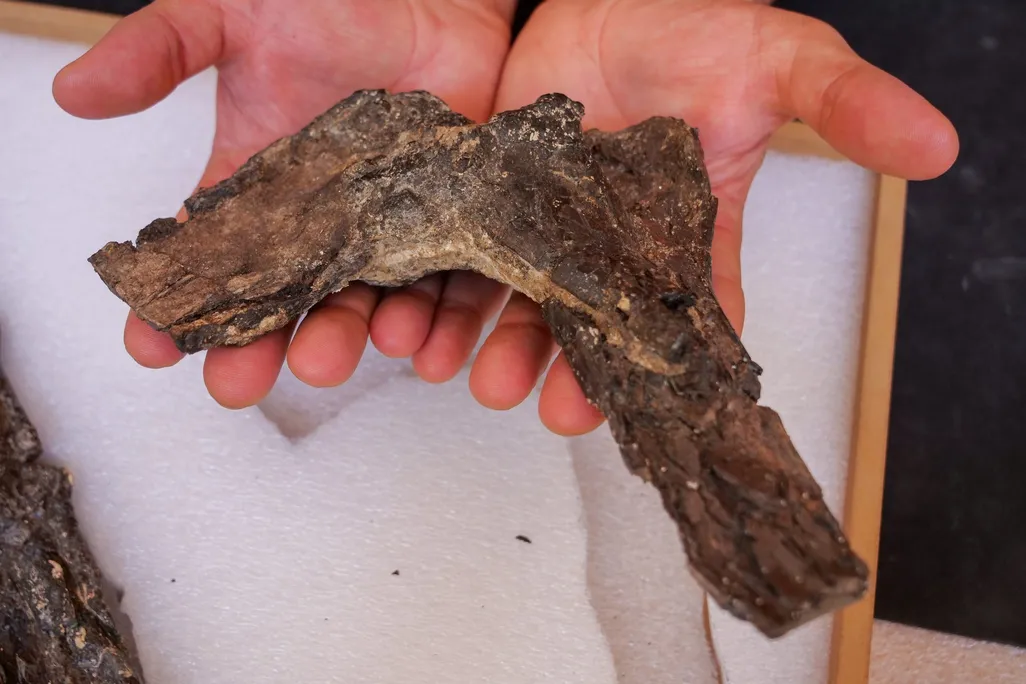
Scientists Confirm 115-Million-Year-Old Dinosaur Blood Molecules Preserved Inside Fossil Bone
Discover more from NEWS THAT MOVES YOU
Subscribe to get the latest posts sent to your email.
Leave a Reply