
COLORADO SPRINGS, Colo. — Astronomers operating the European Southern Observatory’s Very Large Telescope in Chile’s Atacama Desert have discovered an unprecedented double ring of vaporized planetary wreckage orbiting a dead white dwarf star, offering a rare preview of what may await our own Solar System billions of years in the future, according to a European Southern Observatory release on ScienceDaily. Published in the journal Nature Astronomy, the study focuses on white dwarf J1328−1450, the dense, exposed core of a Sun-like star that exhausted its nuclear fuel and shed its outer layers.
Using the Very Large Telescope’s X-Shooter spectrograph to analyze light across a wide range of wavelengths, lead author Nicola Gentile Fusillo of the Università degli Studi di Trieste and his colleagues found that the gaseous debris surrounding J1328−1450 is split into two concentric, stable rings separated by a distinct gap. Previously observed planetary debris systems around white dwarfs have exhibited only a single, flat rotating disc, making J1328−1450 the first known system with a double debris disc, as detailed in ScienceDaily.
Spectroscopic analysis confirmed that the rings contain calcium, oxygen, magnesium, and iron—elements characteristic of shattered rocky planets rather than leftover stellar gas. Intriguingly, the two rings display sharply different chemical profiles: the inner ring is rich in magnesium gas, whereas the outer ring is largely depleted of magnesium. Researchers noted in ScienceDaily that this compositional divide indicates either the destruction of two separate rocky worlds or the separation of a single planet’s outer crust from its metallic core.
To explain how the two gaseous rings remain cleanly separated, the research team—including co-author Felipe Lagos-Vilches of the University of Warwick and Chile’s Universidad Técnica Federico Santa María—concluded that two surviving planetary bodies are gravitationally sculpting the gap. While the inner shepherd body is estimated to be the size of a standard asteroid measuring a few kilometers across, the outer survivor could be as large as Pluto or Earth’s Moon, demonstrating that substantial planetary remnants can endure the violent death of their host star
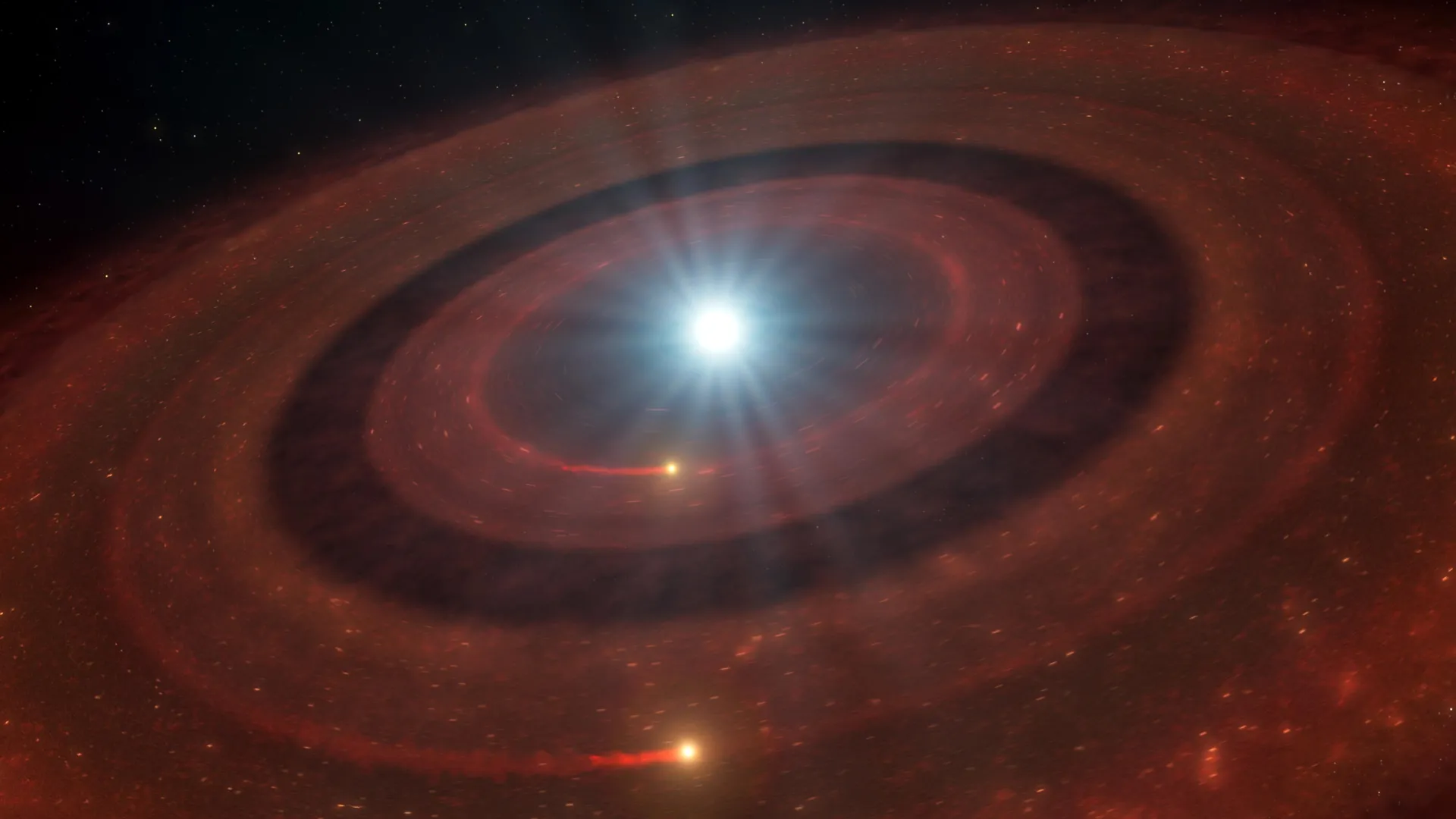
Double Ring of Planetary Debris Around Dead Star Offers Preview of Our Solar System’s Fate
Discover more from NEWS THAT MOVES YOU
Subscribe to get the latest posts sent to your email.
Leave a Reply